
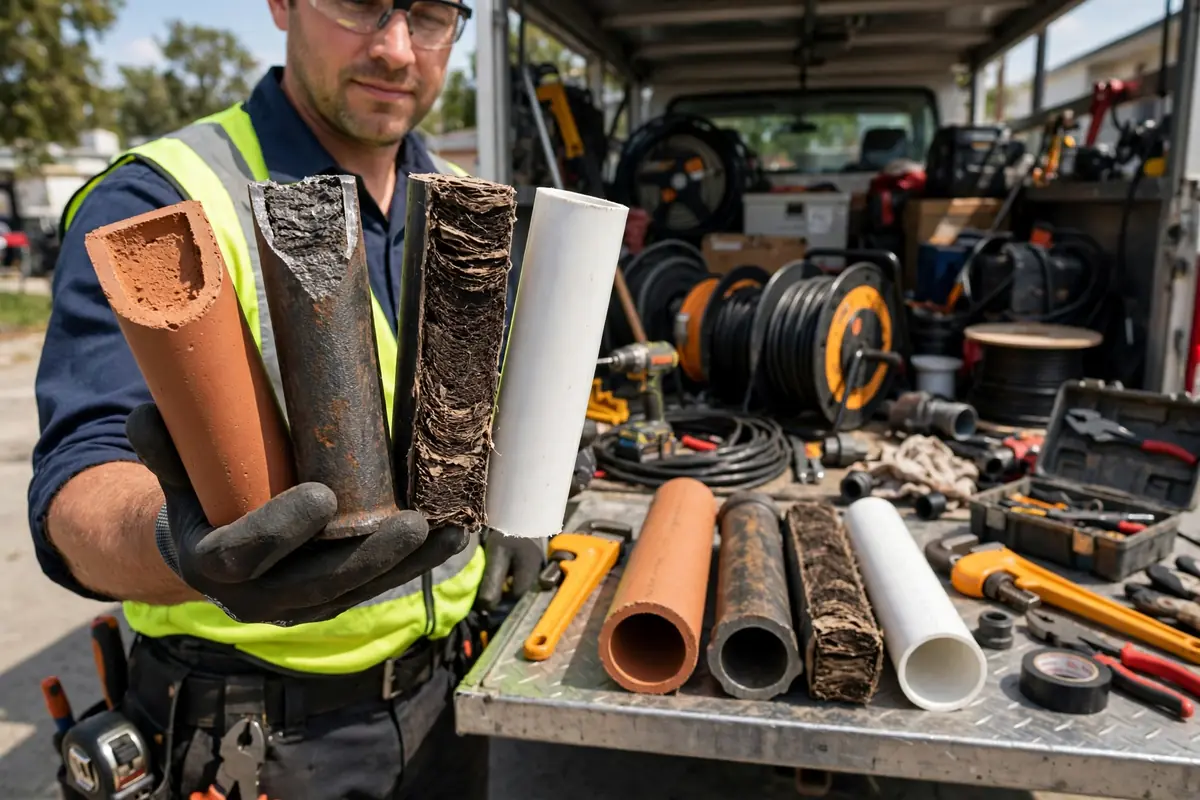
Vitrified Clay: Corrosion-Proof but Brittle
Clay's superpower is chemical immunity — it does not corrode, no matter what flows through it. In stable soils with mild winters, clay lines have served for the better part of a century. The material itself is nearly indestructible by chemistry.
Illinois winters exploit clay's weakness instead: brittleness. Freeze-thaw heave flexes the ground every year, and rigid clay absorbs that movement as stress concentrated at its many joints. Short two-foot sections mean many joints, and each joint is a frost-and-root battleground.
Verdict for our climate: serviceable but vulnerable. A clay line in good soil with intact joints can keep going, but every winter tests those joints, and root intrusion at failed joints is the leading clay killer in the Chicago suburbs.
Cast Iron: Strong Until Corrosion Wins
Cast iron brought real structural strength to sewer lines — it handles soil loads and traffic that would crush weaker materials, and its long sections meant fewer joints than clay. Mid-century Bartlett homes with original cast iron laterals benefited from that toughness for decades.
The enemy is internal corrosion. Sewer gases convert to sulfuric acid on the pipe crown, thinning the top of the pipe in a process called crown corrosion, while the flow line corrodes from constant wastewater contact. The pipe looks solid from outside while hollowing from within.
Winter adds a secondary threat: corroded, thinned cast iron is more vulnerable to cracking when frost heave shifts the ground. Verdict: strong pipe with a finite chemical clock, and our freeze-thaw cycles spend that clock faster once corrosion has thinned the walls.
PVC and ABS: The Modern Flexible Standard
PVC (and its cousin ABS) dominate modern installations for good reasons. Long twenty-foot sections mean far fewer joints, the plastic is chemically inert to sewer corrosion, and — crucially for Illinois — it flexes with ground movement instead of cracking. Frost heave that fractures clay simply bends PVC and lets it spring back.
The joints, solvent-welded or gasketed, are root-resistant when properly installed, and the smooth interior resists the scale buildup that plagues cast iron. Properly bedded PVC in our soils has a service life measured in a century.
The caveat is installation quality. PVC's flexibility is a strength in the ground but a weakness during installation: poor bedding lets rocks press into the wall, and heavy equipment over a shallow trench can deform it. Well-installed PVC is the strongest winter performer of the traditional materials; poorly installed PVC fails young.
HDPE: The Trenchless Champion
High-density polyethylene arrives in continuous runs with heat-fused joints — effectively one single piece of pipe from house to street. No joints means no joint failures, the leading cause of sewer line problems across every other material. It flexes with freeze-thaw, ignores corrosion, and shrugs off root pressure.
HDPE is the standard material for pipe bursting installations, which is why trenchless replacements in Bartlett so often end with an HDPE line. It is also the most forgiving material in unstable or heaving soils — exactly the conditions our winters create.
Verdict: the strongest all-around performer for Illinois conditions. If you are replacing a line and want the material least likely to trouble the next owner, fused HDPE is the answer.
Orangeburg: The One to Replace on Sight
Orangeburg — bituminized fiber pipe used from the 1940s through the 1970s — deserves its reputation as the worst sewer pipe material. It was essentially tar-soaked paper rolled into a tube, and it deforms under sustained soil pressure, flattening into an oval over decades.
Illinois conditions are uniquely cruel to Orangeburg. Frost heave, wet spring soils, and root pressure accelerate a deformation process that was already inevitable. Orangeburg lines in our area routinely fail at thirty to fifty years — well short of every other material on this list.
Verdict: if a camera inspection finds Orangeburg under your Bartlett home, plan its replacement rather than its repair. No cleaning or lining strategy overcomes a material that is structurally dissolving; our pipe replacement guide covers the options, and a replacement assessment in Bartlett starts with the camera — call (833) 713-2101.