
Pipe Bursting in Bartlett, IL
Pipe bursting is the trenchless replacement method: a powerful bursting head is pulled through the old sewer line, fracturing the existing pipe outward into the surrounding soil, while a brand-new pipe — typically high-density polyethylene, or HDPE — follows immediately behind it into the same bore. The old line's path becomes the new line's path.
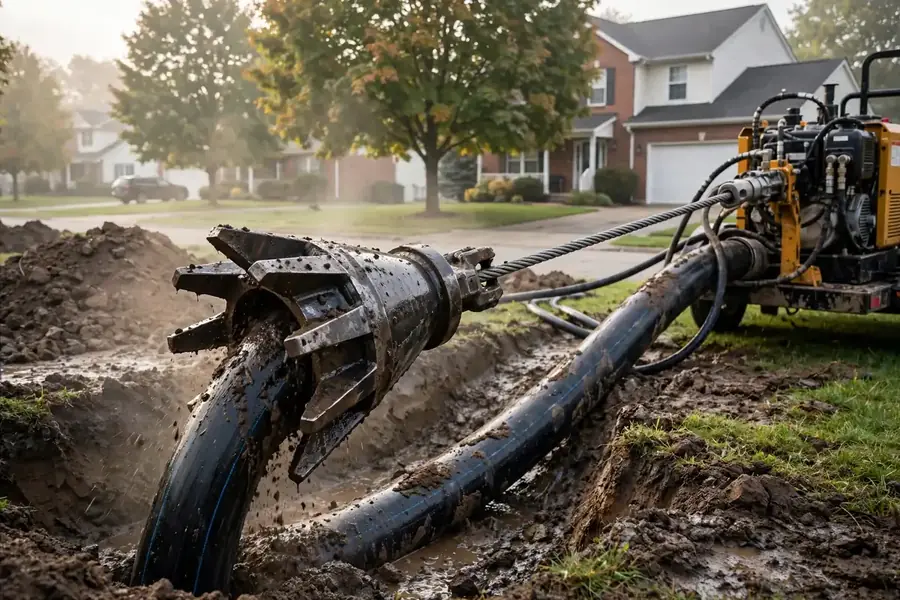
In short: Pipe bursting replaces Bartlett, IL 60103 sewer lines by fracturing the old pipe outward while pulling new HDPE pipe through — only two access pits, no open trench. The first step is a camera inspection to confirm the line is a bursting candidate; call (833) 713-2101 to schedule one.
Pipe Bursting
Pipe bursting is the trenchless replacement method: a powerful bursting head is pulled through the old sewer line, fracturing the existing pipe outward into the surrounding soil, while a brand-new pipe — typically high-density polyethylene, or HDPE — follows immediately behind it into the same bore. The old line's path becomes the new line's path. Two access pits, one at each end of the run, replace the open trench that traditional replacement would carve across the property.
The method has a particular calling in the northwest suburbs. Postwar and 1960s–70s neighborhoods across Addison, Elk Grove Village, Streamwood, and Hanover Park still carry Orangeburg fiber pipe — a bituminized material that deforms into ovals and delaminates with age, and that bursting handles almost better than any other method because the brittle old pipe fractures cleanly. Clay-tile laterals with failed joints burst well too. What bursting needs is a traceable path: the head must be able to travel the line's route, which the camera inspection verifies before anyone commits.
When Pipe Bursting Is the Right Call
Bursting replaces pipe rather than repairing it, so it fits lines that are done as lines. The camera findings that point to bursting:
- Orangeburg pipe at end of life — Deformed, delaminated fiber pipe from the 1940s–1970s is bursting's signature case. The brittle material fractures outward cleanly while HDPE takes its place — no trench needed along the run.
- Collapsed sections with a traceable path — Where the pipe has caved but the route is still followable, the bursting head can power through and re-establish the bore. Lining cannot fix collapse; bursting can.
- Clay tile with pervasive joint failure — A clay lateral where every joint has separated or admitted roots has no structure worth lining. Bursting replaces the whole run with jointless HDPE in one operation.
- A failed line under landscaping worth saving — Mature trees, irrigation, patios, and driveways make open trenching expensive in restoration alone. Bursting's two-pit footprint preserves everything between them.
- Undersized pipe needing upsizing — Bursting can pull in a larger-diameter pipe than the one it replaces — useful where the original lateral was undersized for the home's fixtures and chronic slow drainage resulted.
- Root-destroyed runs beyond spot repair — When roots have invaded at every joint and crushed segments between intrusions, cutting and lining individual spots is false economy. Bursting renews the entire run at once.
How Pipe Bursting Works, Step by Step
Bursting is forceful work done with precision. The sequence:
- 1
Camera mapping and bursting plan
The lateral is camera-mapped for length, diameter, depth, and defect locations. The crew confirms the path is traceable, checks for nearby utilities, and sizes the bursting head and new HDPE to the run.
- 2
Entry and exit pits
Two excavations go in — typically one near the foundation and one near the street or main connection. Their positions are chosen to spare landscaping, driveways, and hardscaping between them.
- 3
Cable or rod through the old line
A steel cable or bursting rod is threaded through the existing pipe from one pit to the other, establishing the pull path the head will follow.
- 4
The burst pull
The bursting head — a cone larger than the old pipe — is drawn through the line by hydraulic power, fracturing the old pipe outward into the soil while the new HDPE pipe follows directly behind it into the fresh bore.
- 5
Connections at both ends
The new HDPE is connected to the home's drainage at the foundation and to the municipal tap at the street, with proper fittings and verified grade.
- 6
Backfill, restoration, and camera verification
The pits are backfilled in compacted lifts, surfaces are restored, and the camera runs the new line to document a continuous, jointless replacement.
Equipment and Materials Used
Bursting rigs are among the most powerful tools in sewer work:
- Hydraulic bursting units with pulling force rated to the run's length and soil
- Expander heads sized to fracture the old pipe and make room for the new diameter
- High-density polyethylene (HDPE) pipe in continuous lengths — jointless along the run
- Steel pull cables or bursting rods threaded through the existing line
- Excavation equipment for the entry and exit pits
- Push cameras and locators for the pre-burst mapping and post-burst verification
HDPE's flexibility is what makes the pull possible — the pipe bends through the bore path in one continuous length, which is also why the finished line has no joints for roots to exploit.
Safety and Precautions
Bursting applies tons of pulling force underground, so the pre-job utility locate is the single most important safety step: gas, electric, water, and telecom lines near the lateral's path must be marked, and the bursting plan adjusted where utilities crowd the corridor. The pits are excavated to standard trench safety practice, and the pull zone stays clear of everyone but the crew — a cable under that much tension is not something to stand near. Vibration and ground movement are monitored where the run passes near foundations, pools, or retaining walls.
Homeowners should expect the drains to be out of service during the pull and reconnection, with a clear timeline from the crew. Ask how the new line's grade is verified — proper slope is what keeps the replacement working for decades — and confirm the permit and inspection steps for your municipality before the pits are dug. Keep children and pets well away from the pits and the bursting rig while work is underway.
Why Bursting Fits So Many Bartlett-Area Lines
The area's Orangeburg belt is bursting's natural territory. Addison (median build 1972), Elk Grove Village (1974), Streamwood, and Hanover Park carry the region's heaviest concentration of 1960s–70s fiber pipe — material now 50-plus years old and behaving exactly as its lifespan predicts. Bursting was, in a real sense, designed for this pipe: brittle, deformed, and lying in clay soil that holds the expanded bore open while the HDPE follows. Whole streets in these suburbs are reaching the replacement window together.
Clay soil helps the method and complicates the pits. The dense glacial clay fractures and holds shape around the bursting head, but it digs heavy and slow, so pit placement on tight suburban lots takes planning — side yards, parkway strips, and driveway edges each get evaluated. Deep frost-line laterals (six to nine feet is common) make open trenching disproportionately expensive here, which is why the two-pit bursting footprint so often wins the cost-and-disruption comparison on Bartlett-area lots.
Pipe Bursting Across the Service Area
Every community gets pipe bursting — pick yours.
Pipe Bursting in Addison
Pipe Bursting in Addison 60101 — new HDPE pulled through; old pipe fractured outward; postwar pipe by Salt Creek, Addison.
Pipe Bursting in Bartlett
Pipe Bursting in Bartlett 60103 — new HDPE pulled through; old pipe fractured outward; newer PVC; wetland tables, Bartlett.
Pipe Bursting in Bloomingdale
Pipe Bursting in Bloomingdale 60108 — new HDPE pulled through; old pipe fractured outward; transition-era pipe, Bloomingdale.
Pipe Bursting in Carol Stream
Pipe Bursting in Carol Stream 60188 — new HDPE pulled through; old pipe fractured outward; planned PVC; industrial demand, Carol Stream.
Pipe Bursting in East Dundee
Pipe Bursting in East Dundee 60118 — new HDPE pulled through; old pipe fractured outward; Fox River clay; 2000s PVC, East Dundee.
Pipe Bursting in Elgin
Pipe Bursting in Elgin 60120 — new HDPE pulled through; old pipe fractured outward; century clay and iron, Elgin.
Pipe Bursting in Elk Grove Village
Pipe Bursting in Elk Grove Village 60007 — new HDPE pulled through; old pipe fractured outward; Centex Orangeburg aging, Elk Grove Village.
Pipe Bursting in Geneva
Pipe Bursting in Geneva 60134 — new HDPE pulled through; old pipe fractured outward; downtown clay; valley watch, Geneva.
Pipe Bursting in Glendale Heights
Pipe Bursting in Glendale Heights 60139 — new HDPE pulled through; old pipe fractured outward; 1960s–70s cohort ending, Glendale Heights.
Pipe Bursting in Hanover Park
Pipe Bursting in Hanover Park 60133 — new HDPE pulled through; old pipe fractured outward; 1970s clay and Orangeburg, Hanover Park.
Pipe Bursting in Hoffman Estates
Pipe Bursting in Hoffman Estates 60192 — new HDPE pulled through; old pipe fractured outward; multi-era quadrants, Hoffman Estates.
Pipe Bursting in Itasca
Pipe Bursting in Itasca 60143 — new HDPE pulled through; old pipe fractured outward; 1840s to 2010s pipe, Itasca.
Pipe Bursting in Palatine
Pipe Bursting in Palatine 60067 — new HDPE pulled through; old pipe fractured outward; 60–150-year downtown clay, Palatine.
Pipe Bursting in Rolling Meadows
Pipe Bursting in Rolling Meadows 60008 — new HDPE pulled through; old pipe fractured outward; 1950s–60s clay, Rolling Meadows.
Pipe Bursting in Roselle
Pipe Bursting in Roselle 60172 — new HDPE pulled through; old pipe fractured outward; 1970s Orangeburg window, Roselle.
Pipe Bursting in Schaumburg
Pipe Bursting in Schaumburg 60193 — new HDPE pulled through; old pipe fractured outward; Woodfield transition; I-90, Schaumburg.
Pipe Bursting in South Elgin
Pipe Bursting in South Elgin 60177 — new HDPE pulled through; old pipe fractured outward; youngest stock, precision, South Elgin.
Pipe Bursting in St. Charles
Pipe Bursting in St. Charles 60174 — new HDPE pulled through; old pipe fractured outward; three-era Fox mosaic, St. Charles.
Pipe Bursting in Streamwood
Pipe Bursting in Streamwood 60107 — new HDPE pulled through; old pipe fractured outward; Orangeburg risk; shape first, Streamwood.
Pipe Bursting in Wayne
Pipe Bursting in Wayne 60184 — new HDPE pulled through; old pipe fractured outward; estate laterals; vintage clay, Wayne.
Pipe Bursting in West Chicago
Pipe Bursting in West Chicago 60185 — new HDPE pulled through; old pipe fractured outward; century railroad-core pipe, West Chicago.
Pipe Bursting in Wood Dale
Pipe Bursting in Wood Dale 60191 — new HDPE pulled through; old pipe fractured outward; 1960s–70s; Salt Creek floodplain, Wood Dale.
Pipe Bursting FAQs
Can pipe bursting upsize my sewer line?
Yes — one of bursting's advantages is pulling in a larger-diameter pipe than the one it replaces. If the original lateral was undersized for the home, upsizing during the burst solves chronic capacity problems permanently.
What happens to the old pipe?
It is fractured outward into the surrounding soil as the bursting head passes, and the fragments remain buried around the new HDPE line. There is nothing to haul away along the run — only the material from the two access pits.
Will bursting damage nearby utilities or my foundation?
The pre-job locate maps every utility near the path, and the plan is adjusted where crossings are tight. The crew also evaluates proximity to foundations and structures before pulling. This planning step is what makes bursting safe.
How long does a bursting job take?
Most residential bursting runs complete in one to two days: camera and prep, the pull itself, connections, and backfill. Restoration of the two pit areas follows on an agreed schedule.
Is bursting cheaper than digging a trench?
The pipe work itself is comparable, but the total project usually costs less because surface restoration — lawn, driveway, landscaping along the full lateral path — shrinks to two pit areas. On deep or landscaped lots the difference is substantial.
Sewer Line Problems Don’t Wait. Neither Should You.
Your local pipe bursting specialist for Bartlett, IL and nearby suburbs is one free call away — 24/7.
(833) 713-2101Free to call · No obligation · 24/7 emergency line
Serving Bartlett, IL and surrounding suburbs