
Trenchless Sewer Repair in Bartlett, IL
Trenchless sewer repair is a family of methods that repair or replace a buried sewer line without digging it up end to end. Instead of an open trench across the yard, driveway, or patio, technicians work through one or two small access pits — sometimes through an existing cleanout — and renew the pipe from the inside or pull a new pipe through the old one's path.
In short: Trenchless sewer repair fixes Bartlett, IL 60103 sewer lines through small access points instead of an open trench, using pipe bursting or cured-in-place lining. The first step is always a camera inspection — call (833) 713-2101 to schedule one and learn whether your line qualifies.
Trenchless Sewer Repair
Trenchless sewer repair is a family of methods that repair or replace a buried sewer line without digging it up end to end. Instead of an open trench across the yard, driveway, or patio, technicians work through one or two small access pits — sometimes through an existing cleanout — and renew the pipe from the inside or pull a new pipe through the old one's path. For Bartlett-area homeowners, that distinction matters enormously: the same mature landscaping, concrete driveways, and finished yards that make these suburbs attractive are exactly what open-trench excavation destroys.
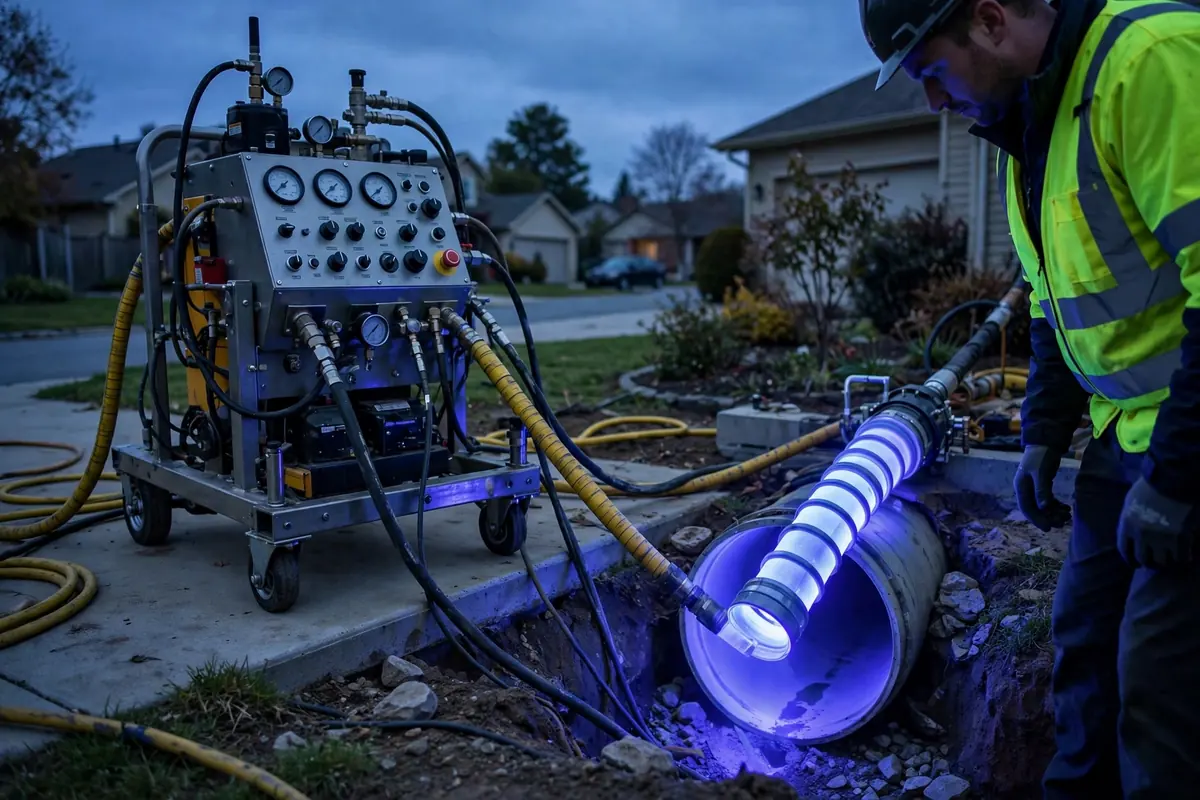
Two methods do most trenchless work. Pipe bursting fractures the old pipe outward while pulling a new high-density polyethylene line into place behind it. Cured-in-place pipe lining (CIPP) installs a resin-saturated liner inside the existing pipe and cures it into a smooth, jointless new pipe within the old one. Which method fits depends on what the camera finds: bursting handles collapsed or badly deformed pipe, while lining needs a host pipe with enough structural integrity to hold the liner. A camera inspection settles that question before anyone commits to a method.
Signs a Trenchless Repair May Fit Your Line
Trenchless methods solve specific problems. These are the symptoms that most often lead to a trenchless recommendation in the northwest suburbs:
- Recurring backups with an intact pipe path — When drains back up repeatedly but the line hasn't fully collapsed, the pipe's route is usually still viable — exactly what bursting or lining needs. The camera confirms the path is traceable before trenchless work begins.
- Root intrusion at the joints — Clay-tile and cast-iron joints are root magnets. If roots keep returning after cutting, lining seals every joint at once with a seamless interior, removing the entry points instead of fighting the same battle yearly.
- Cracks and offset joints without total collapse — A camera showing cracked sections or joints that have shifted a few inches — but pipe that still holds its round shape — is the classic lining candidate. The liner bridges those defects and restores a smooth bore.
- A failed line under expensive surfaces — Driveways, patios, retaining walls, mature trees, and additions all raise the cost of open trenching far beyond the pipe work itself. When the surface above the line is worth protecting, trenchless math usually wins.
- Orangeburg or thin-wall pipe at end of life — Postwar neighborhoods across Addison, Elk Grove Village, and Streamwood still carry Orangeburg laterals from the 1960s–70s. Bursting replaces that deformed fiber pipe with new HDPE without excavating its full length.
- A line the city or an inspector flagged — Failed point-of-sale inspections and municipal defect notices often name the defect precisely. Bring that paperwork to the call at (833) 713-2101 — it tells the specialist which trenchless method to evaluate first.
How Trenchless Sewer Repair Works, Step by Step
Every trenchless job follows the same disciplined sequence. Skipping steps is how trenchless projects fail, so a reputable crew will not skip them:
- 1
Camera inspection and measurement
A push camera maps the line: length, depth, diameter, defects, and exact locations. The footage is recorded so you can see what the technician sees. This step also confirms the line is a trenchless candidate at all.
- 2
Cleaning the host pipe
For lining, the old pipe is cleaned — usually with hydro jetting or mechanical cutters — so the liner bonds to a sound surface. For bursting, the path is verified clear enough for the bursting head to travel.
- 3
Access pits at entry and exit
Small excavations go in at the start and end of the repair run. On many Bartlett-area lots these sit in the yard near the foundation and near the street connection, sparing everything in between.
- 4
Bursting or lining the run
In bursting, a cone-shaped head fractures the old pipe outward while new HDPE pipe follows directly behind it. In lining, the resin liner is inverted or pulled into place, then cured with hot water, steam, or UV light into a hard, jointless pipe.
- 5
Service connections reinstated
After lining, a robotic cutter reopens each branch connection from inside the new liner — toilets, sinks, and laundry reconnect without digging to each one.
- 6
Final camera verification
The camera runs the renewed line end to end. You see the smooth new interior on the monitor, and the footage documents the completed work.
Equipment and Materials Used
Trenchless work is equipment-intensive, which is one reason the method demands a specialist rather than a generalist:
- Push camera systems with locators that map depth and position from above ground
- Hydro jetters and chain-flail cutters for preparing the host pipe
- Bursting rigs with hydraulic or pneumatic heads sized to the pipe diameter
- Cured-in-place liners with epoxy or polyester resin, calibrated to the line's length
- High-density polyethylene (HDPE) replacement pipe for bursting runs
- Robotic reinstatement cutters that reopen branch connections from inside liners
The liner and HDPE used in trenchless work create a jointless run — and joints are where roots enter and where clay tile traditionally fails. That jointless quality is a large part of why trenchless renewals hold up.
Safety and Precautions
Resin systems used in CIPP lining involve chemicals that must be handled with ventilation and protective equipment; the work area stays clear of occupants while resin is mixed and curing. Bursting generates significant pulling force, so the crew verifies that nearby utilities — gas, electric, water, telecom — are located and marked before the head ever moves. In the northwest suburbs, where utility easements crowd the same corridor as the sewer lateral, that locate step is non-negotiable.
Homeowners should keep children and pets away from access pits and equipment, and should not use drains during the lining cure window — the technician will give a clear all-clear time. If your home has a history of backups, ask about a backwater valve during the same visit; with the line already under repair, it is the natural moment to discuss backup protection. And as with any buried-pipe work, the crew should confirm local permit and inspection requirements for your municipality before work begins.
Trenchless Repair and Bartlett-Area Conditions
Bartlett-area soil is mostly glacial clay — poor drainage, high shrink-swell, and a habit of shifting around buried pipe with every wet spring. That movement is what opens joints and creates the offsets that trenchless lining bridges so well. Winter frost drives three to four feet down and heaves shallow pipe, another joint-killer that shows up on camera as separated hubs. A trenchless renewal that leaves a jointless pipe behind is particularly well suited to ground that never sits still.
The housing stock decides which trenchless method appears most. Postwar and 1960s–70s neighborhoods — Addison, Elk Grove Village, Streamwood, Rolling Meadows — carry Orangeburg and clay-tile laterals where bursting often fits. Newer PVC subdivisions in South Elgin or Carol Stream more often need lining for isolated defects or bursting only where settlement has deformed the run. Either way, the camera makes the call: trenchless is a diagnosis-led method, and in these suburbs the diagnosis is rarely the same twice on the same street.
Trenchless Sewer Repair Across the Service Area
Every community gets trenchless sewer repair — pick yours.
Trenchless Sewer Repair in Addison
Trenchless Sewer Repair in Addison 60101 — camera-planned no-dig renewal by bursting or lining; postwar pipe by Salt Creek, Addison.
Trenchless Sewer Repair in Bartlett
Trenchless Sewer Repair in Bartlett 60103 — camera-planned no-dig renewal by bursting or lining; newer PVC; wetland tables, Bartlett.
Trenchless Sewer Repair in Bloomingdale
Trenchless Sewer Repair in Bloomingdale 60108 — camera-planned no-dig renewal by bursting or lining; transition-era pipe, Bloomingdale.
Trenchless Sewer Repair in Carol Stream
Trenchless Sewer Repair in Carol Stream 60188 — camera-planned no-dig renewal by bursting or lining; planned PVC; industrial demand, Carol Stream.
Trenchless Sewer Repair in East Dundee
Trenchless Sewer Repair in East Dundee 60118 — camera-planned no-dig renewal by bursting or lining; Fox River clay; 2000s PVC, East Dundee.
Trenchless Sewer Repair in Elgin
Trenchless Sewer Repair in Elgin 60120 — camera-planned no-dig renewal by bursting or lining; century clay and iron, Elgin.
Trenchless Sewer Repair in Elk Grove Village
Trenchless Sewer Repair in Elk Grove Village 60007 — camera-planned no-dig renewal by bursting or lining; Centex Orangeburg aging, Elk Grove Village.
Trenchless Sewer Repair in Geneva
Trenchless Sewer Repair in Geneva 60134 — camera-planned no-dig renewal by bursting or lining; downtown clay; valley watch, Geneva.
Trenchless Sewer Repair in Glendale Heights
Trenchless Sewer Repair in Glendale Heights 60139 — camera-planned no-dig renewal by bursting or lining; 1960s–70s cohort ending, Glendale Heights.
Trenchless Sewer Repair in Hanover Park
Trenchless Sewer Repair in Hanover Park 60133 — camera-planned no-dig renewal by bursting or lining; 1970s clay and Orangeburg, Hanover Park.
Trenchless Sewer Repair in Hoffman Estates
Trenchless Sewer Repair in Hoffman Estates 60192 — camera-planned no-dig renewal by bursting or lining; multi-era quadrants, Hoffman Estates.
Trenchless Sewer Repair in Itasca
Trenchless Sewer Repair in Itasca 60143 — camera-planned no-dig renewal by bursting or lining; 1840s to 2010s pipe, Itasca.
Trenchless Sewer Repair in Palatine
Trenchless Sewer Repair in Palatine 60067 — camera-planned no-dig renewal by bursting or lining; 60–150-year downtown clay, Palatine.
Trenchless Sewer Repair in Rolling Meadows
Trenchless Sewer Repair in Rolling Meadows 60008 — camera-planned no-dig renewal by bursting or lining; 1950s–60s clay, Rolling Meadows.
Trenchless Sewer Repair in Roselle
Trenchless Sewer Repair in Roselle 60172 — camera-planned no-dig renewal by bursting or lining; 1970s Orangeburg window, Roselle.
Trenchless Sewer Repair in Schaumburg
Trenchless Sewer Repair in Schaumburg 60193 — camera-planned no-dig renewal by bursting or lining; Woodfield transition; I-90, Schaumburg.
Trenchless Sewer Repair in South Elgin
Trenchless Sewer Repair in South Elgin 60177 — camera-planned no-dig renewal by bursting or lining; youngest stock, precision, South Elgin.
Trenchless Sewer Repair in St. Charles
Trenchless Sewer Repair in St. Charles 60174 — camera-planned no-dig renewal by bursting or lining; three-era Fox mosaic, St. Charles.
Trenchless Sewer Repair in Streamwood
Trenchless Sewer Repair in Streamwood 60107 — camera-planned no-dig renewal by bursting or lining; Orangeburg risk; shape first, Streamwood.
Trenchless Sewer Repair in Wayne
Trenchless Sewer Repair in Wayne 60184 — camera-planned no-dig renewal by bursting or lining; estate laterals; vintage clay, Wayne.
Trenchless Sewer Repair in West Chicago
Trenchless Sewer Repair in West Chicago 60185 — camera-planned no-dig renewal by bursting or lining; century railroad-core pipe, West Chicago.
Trenchless Sewer Repair in Wood Dale
Trenchless Sewer Repair in Wood Dale 60191 — camera-planned no-dig renewal by bursting or lining; 1960s–70s; Salt Creek floodplain, Wood Dale.
Trenchless Sewer Repair FAQs
Does trenchless sewer repair work on every pipe?
No. The line must have a traceable path and enough integrity for the method — lining needs a host pipe that holds its shape, bursting needs room to expand the old pipe outward. Collapsed sections with missing pipe, severe bellies holding standing water, or lines with improper grade may need open excavation. The camera inspection determines candidacy.
How long does a trenchless repair take?
Most residential trenchless runs complete in one to two days once the camera work and cleaning are done — far less yard disruption than open trenching. Lining adds a cure window during which drains stay unused; your technician gives the exact all-clear time.
Will trenchless repair damage my yard at all?
Two small access pits are still excavations, and equipment needs staging room. But compared with an open trench along the full lateral, the surface impact is a fraction — landscaping, driveways, and patios between the pits stay intact.
Is the new pipe as good as a traditionally replaced one?
The HDPE pipe pulled in by bursting and the cured liner installed by CIPP are both jointless, root-resistant renewals. Joints are the historic failure point of clay and cast-iron systems, so eliminating them addresses the most common failure mode directly.
How do I know if my line qualifies for trenchless?
Schedule a camera inspection by calling (833) 713-2101. The footage shows the pipe's material, shape, and defects — the three facts that decide between bursting, lining, or open repair. Any recommendation made without that footage is a guess.
Sewer Line Problems Don’t Wait. Neither Should You.
A local trenchless sewer repair specialist serving Bartlett, IL and nearby communities is standing by — call 24/7.
(833) 713-2101Free to call · No obligation · 24/7 emergency line
Serving Bartlett, IL and surrounding suburbs