
Sewer Line Repair in Bloomingdale, IL
Bloomingdale sits astride one of the most consequential divides in suburban plumbing: the Orangeburg-to-PVC transition. With a median build year of 1981, the village's housing stock splits almost evenly — about 41% raised in the 1960s–70s on cast iron and Orangeburg, about 43% raised in the 1980s–90s on PVC and ABS.
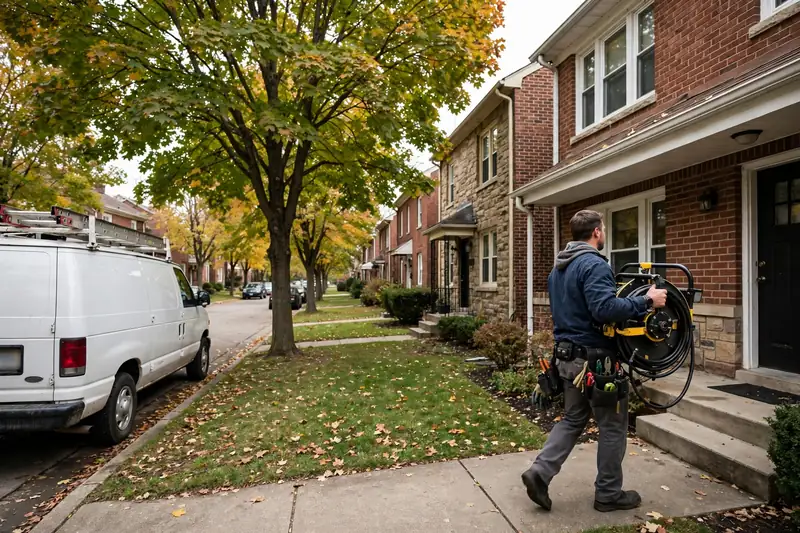
In short: In Bloomingdale, IL 60108, sewer repair starts with a camera inspection — call (833) 713-2101. Bloomingdale's 1981-median stock straddles the Orangeburg-to-PVC transition, so laterals need material-specific diagnosis before any repair.
Bloomingdale
Bloomingdale sits astride one of the most consequential divides in suburban plumbing: the Orangeburg-to-PVC transition. With a median build year of 1981, the village's housing stock splits almost evenly — about 41% raised in the 1960s–70s on cast iron and Orangeburg, about 43% raised in the 1980s–90s on PVC and ABS. Two houses on the same street can carry laterals from different pipe centuries, which is why generic sewer advice fails here and camera inspection is the only honest starting point.
The village's setting sharpens the picture. Forest-preserve-adjacent lots with mature trees and streams run through parts of Bloomingdale, and mature trees over jointed pipe mean root pressure — the defining maintenance item for the older band. The newer band's PVC fails more quietly: settlement, isolated defects, root entry at the occasional joint. Knowing which band an address belongs to is step one; the camera confirms it as step two.
Area Facts
- Verified ZIP
- 60108 — the Village of Bloomingdale's sole official ZIP.
- Median year built
- 1981 (CMAP April-2025); 41% built 1960–79, 43% built 1980–99.
- Expected pipe classes
- Orangeburg-to-PVC transition: cast iron + Orangeburg in the older band, PVC/ABS in the newer.
- Housing mix
- ~44% single-family detached + ~24% attached; ranch, split-level, and 2-story styles.
- Soil
- DuPage County glacial clay — poor drainage, seasonal shrink-swell movement.
- Setting
- Forest-preserve-adjacent lots with mature trees and streams in parts of the village.
Housing Stock and What It Means for Sewer Lines
The 1960s–79 band is the watch zone. Cast-iron laterals from this era scale internally and admit roots at joints; Orangeburg laterals deform and delaminate as they pass 50 years. A 1973 ranch — a common Bloomingdale listing type — is squarely in this window, and its lateral deserves a camera look even without symptoms, because Orangeburg failure is invisible until it is advanced. Where the camera finds deformation, pipe bursting is the purpose-built answer; where it finds joint-separated clay or iron holding shape, lining seals the run.
The 1980s–99 band runs PVC and ABS — materials that do not decay on a schedule. Their issues are installation-era: trench backfill that settled into bellies, joints stressed by the clay's movement, and root entry where gaskets aged. Repairs here trend toward lining isolated defects and spot repairs rather than full replacement. The attached-housing share (about a quarter of stock) adds shared-lateral considerations: townhome rows sometimes share runs, so diagnosis occasionally involves neighbors and HOA coordination.
Soil, Water, and Local Setting
DuPage County's glacial clay underlies the village — slow-draining, high shrink-swell soil that moves with every wet-dry cycle and works pipe joints apart over the decades. That movement is the quiet engine behind much of Bloomingdale's joint-separation work: the pipe did not fail so much as the ground would not sit still. Drainage is naturally poor, so infiltration through cracked joints runs heavier in wet springs, and sump systems work harder here than in sandier ground.
Parts of the village back onto forest preserve land, where mature trees, streams, and undisturbed root zones meet suburban laterals at the property line. Those edges are root-intrusion hotspots — the camera often finds the heaviest intrusion on the preserve side of a lot. Finished basements are common in local listings, which raises the stakes of any backup: the lowest drain in a finished basement is the most expensive place for sewage to appear, and the strongest argument for proactive inspection.
How Sewer Service Adapts to Bloomingdale
The transition stock makes Bloomingdale a diagnosis-led market. No responsible recommendation happens without footage, because the repair for a deformed Orangeburg lateral (bursting) and the repair for a bellied PVC lateral (spot repair or re-grade) share nothing but the camera that distinguished them. Inspection first, always — and the inspection report here routinely sorts addresses into their correct pipe century.
For the older band, the service arc runs inspection → bursting or lining → verification, with root management as the standing follow-up where mature trees remain. For the newer band, it runs inspection → targeted repair → maintenance checks on a multi-year interval. The forest-preserve edges get root-cutting schedules, and finished-basement homes get backup-prevention conversations — backwater valves discussed while the line is already under the camera. Same village, two pipe centuries, one disciplined sequence.
Planning Sewer Work in Bloomingdale
Planning sewer work in Bloomingdale starts with refusing to guess the pipe. Because the village straddles the Orangeburg-to-PVC transition, the single most valuable sentence on your service call is your home's build year — it tells the specialist which pipe century to expect before the camera confirms it. A 1973 ranch gets the transition-watch inspection; a 1995 two-story gets the baseline-and-monitor visit. Same village, different jobs.
Two local details deserve mention on the call. First, forest-preserve adjacency: if your lot backs onto preserve land, say so — root pressure runs heavier there and the maintenance interval shortens. Second, shared laterals in the attached-housing stock: if your townhome shares a run, coordinate with the neighbor before the visit so the camera maps the whole shared line in one trip. Planned, camera-led, and neighbor-aware — that is the Bloomingdale sequence.
Sewer Services in Bloomingdale, IL 60108
Twelve services for Bloomingdale — pick yours below.
Commercial Sewer Services in Bloomingdale
Commercial Sewer Services in Bloomingdale 60108 — scoped around operating hours; no downtime; transition-era pipe, Bloomingdale.
Emergency Sewer Repair in Bloomingdale
Emergency Sewer Repair in Bloomingdale 60108 — backups answered round the clock, flow first; transition-era pipe, Bloomingdale.
Pipe Bursting in Bloomingdale
Pipe Bursting in Bloomingdale 60108 — new HDPE pulled through; old pipe fractured outward; transition-era pipe, Bloomingdale.
Pipe Lining in Bloomingdale
Pipe Lining in Bloomingdale 60108 — resin liner cured in place; jointless new line; transition-era pipe, Bloomingdale.
Sewer Camera Inspection in Bloomingdale
Sewer Camera Inspection in Bloomingdale 60108 — live video survey with locate and depth readings; transition-era pipe, Bloomingdale.
Sewer Leak Detection in Bloomingdale
Sewer Leak Detection in Bloomingdale 60108 — camera, pressure, and dye tracing to the leak; transition-era pipe, Bloomingdale.
Sewer Line Cleaning in Bloomingdale
Sewer Line Cleaning in Bloomingdale 60108 — hydro jetting and root cutting, camera-verified clear; transition-era pipe, Bloomingdale.
Sewer Line Installation in Bloomingdale
Sewer Line Installation in Bloomingdale 60108 — new laterals, permitted, graded, and inspected; transition-era pipe, Bloomingdale.
Sewer Line Replacement in Bloomingdale
Sewer Line Replacement in Bloomingdale 60108 — full lateral replacement, trenchless or open-trench; transition-era pipe, Bloomingdale.
Sewer Maintenance in Bloomingdale
Sewer Maintenance in Bloomingdale 60108 — scheduled cleaning and camera checkups on plan; transition-era pipe, Bloomingdale.
Tree Root Removal in Bloomingdale
Tree Root Removal in Bloomingdale 60108 — mechanical root cutting, entry points sealed after; transition-era pipe, Bloomingdale.
Trenchless Sewer Repair in Bloomingdale
Trenchless Sewer Repair in Bloomingdale 60108 — camera-planned no-dig renewal by bursting or lining; transition-era pipe, Bloomingdale.
Sewer Line Repair FAQs in Bloomingdale, IL
Why is a camera inspection especially important in Bloomingdale?
Because the village straddles the Orangeburg-to-PVC transition — neighboring homes can have completely different pipe materials. Only the camera shows which material and condition your specific lateral has.
My home was built in the 1970s. Should I worry about Orangeburg?
It deserves a look. Orangeburg from that era is at or past its expected life, and its failure is invisible from the surface. A camera inspection shows whether the pipe holds its shape or has deformed.
Do tree roots cause most Bloomingdale sewer problems?
For the older jointed-pipe band, roots are the leading issue — especially on forest-preserve-adjacent lots. For newer PVC, roots matter less than settlement and isolated defects.
Is trenchless repair available here?
Yes — bursting for failed Orangeburg and lining for joint-separated pipe that holds shape. Both suit Bloomingdale's lots, where mature landscaping is worth preserving.
What is the first step?
Call (833) 713-2101. Describe your home's age and symptoms, and the specialist will typically schedule a camera inspection to identify your lateral's material and condition.
We share a lateral with our townhome neighbor — now what?
Shared laterals need coordinated diagnosis: the camera maps the whole shared run, and repairs are planned jointly. Mention the shared line when you call so the specialist plans access and communication for both homes.
Sewer Line Problems Don’t Wait. Neither Should You.
Your local sewer service in Bloomingdale specialist for Bartlett, IL and nearby suburbs is one free call away — 24/7.
(833) 713-2101Free to call · No obligation · 24/7 emergency line
Serving Bloomingdale, IL 60108