
Tree Root Removal in Bartlett, IL
Tree roots do not break into sewer pipes — they are invited in. A fine root hair finds the moisture seeping from a tiny joint gap or hairline crack, thickens inside the nutrient-rich flow, and over seasons becomes a mass that catches paper, slows drainage, and eventually blocks the line entirely.
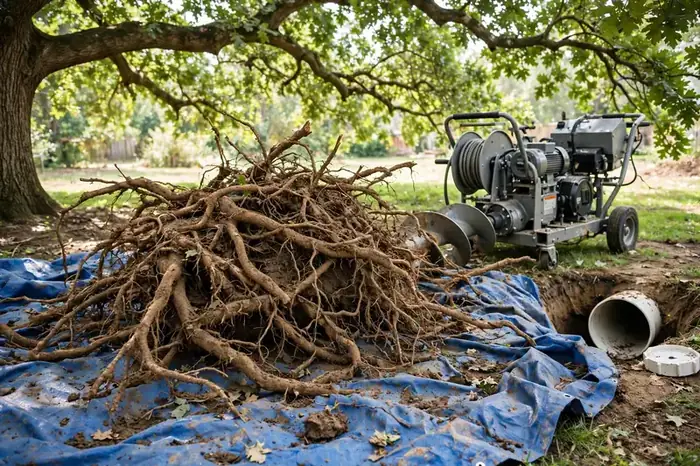
In short: Tree root removal cuts root masses from Bartlett, IL 60103 sewer laterals with mechanical cutters or hydro jetting, then camera-verifies the pipe. The first step is a camera inspection to map the intrusion; call (833) 713-2101 to schedule one.
Tree Root Removal
Tree roots do not break into sewer pipes — they are invited in. A fine root hair finds the moisture seeping from a tiny joint gap or hairline crack, thickens inside the nutrient-rich flow, and over seasons becomes a mass that catches paper, slows drainage, and eventually blocks the line entirely. In the northwest suburbs, with mature maples, oaks, willows, and elms shading nearly every street, root intrusion is the single most common sewer line affliction — and the most misunderstood, because cutting the roots without addressing the entry points guarantees their return.
Removal itself is mechanical: cable-driven cutter heads sized to the pipe shred the mass, and hydro jetting flushes the debris and scours the entry zones. But removal is only half the job. The camera follow-up shows what the roots did on the way in — cracked hubs, separated joints, pipe displaced by root pressure — and that finding decides the second half: schedule recutting, or seal the entries permanently with lining, or replace the destroyed run. A root removal without a camera check afterward is a haircut, not a treatment.
Signs Roots Are in Your Sewer Line
Roots announce themselves through flow problems that worsen in growing season:
- Slow drains that worsen spring through fall — Root growth follows the growing season — a line that drains fine in March and struggles by August is waving a root flag.
- Gurgling toilets after heavy water use — Root masses trap air and restrict flow; the gurgling when laundry or showers run is air escaping past the obstruction.
- Recurring blockages in the same spot — A lateral cleared last year and blocking again this year, at the same distance from the cleanout, is almost certainly roots re-entering through the same joints.
- Toilet paper and debris snagging — Roots catch solids the way a net catches fish. Frequent plunging with no single obvious cause points to a mass downstream.
- Camera footage from a prior visit showing intrusion — If an earlier inspection noted root hairs at joints, those hairs are masses now. Prior footage with root notes is a removal appointment waiting to happen.
- Large trees within 30 feet of the lateral — A mature tree near the line's path plus any drainage symptom equals probable cause — roots travel astonishing distances for pipe moisture.
How Tree Root Removal Works, Step by Step
Effective root work is cut, clear, verify, and plan:
- 1
Camera mapping of the intrusion
The camera locates every root entry — which joints, how far in, how dense the mass — so cutting is targeted, not blind.
- 2
Mechanical cutting
Cable-driven cutter heads, sized to the pipe diameter, shred the root mass. Multiple passes work from the entry point outward until the bore is clear.
- 3
Hydro jetting flush
High-pressure water flushes shredded root material downstream and scours the joint areas, leaving the pipe wall as clean as the structure allows.
- 4
Post-removal camera verification
The camera runs the cleared line to confirm full-bore restoration and — critically — to assess what the roots damaged getting in: cracks, separations, displaced sections.
- 5
Entry-point assessment
Each intrusion point is evaluated: hairline entries in sound pipe versus joints the roots have destroyed. This decides between scheduled recutting and permanent sealing.
- 6
Long-term plan
Options are laid out plainly: maintenance cutting on an interval, pipe lining to seal every joint at once, or replacement where roots have destroyed the pipe's structure.
Equipment and Materials Used
Root work pairs cutting power with diagnostic precision:
- Cable machines with root-cutting heads in multiple diameters
- Hydro jetters with root-slicing and flushing nozzle sets
- Push cameras for pre-cut mapping and post-cut verification
- Locators marking each intrusion point's surface position
- Root-inhibiting maintenance options discussed where appropriate
Cutter head sizing is the skill: too small leaves mass behind, too aggressive damages already-weakened pipe. The camera's read of the pipe wall guides the choice.
Safety and Precautions
Cutting inside a compromised pipe demands restraint — the operator reads the camera's assessment of the pipe wall and moderates cutter aggression where roots have already cracked or displaced sections, because the wrong head at the wrong speed can finish what the roots started. Chemical root killers sold to homeowners deserve caution: caustic products endanger technicians who later work the line, can damage older pipe and septic biology, and never repair the entry points the roots used.
Do not plant the next problem. When landscaping after root work, keep new trees — especially willows, maples, and elms — well away from the lateral's marked route, and ask the technician to mark the line's path before you dig planting holes. Where removal reveals destroyed pipe, take the lining-or-replacement recommendation seriously: recutting a shattered line on schedule is the most expensive way to avoid the real fix.
Roots vs. Pipe in the Bartlett Area
This is root country. The area's mature canopy — maples and oaks in the older suburbs, willows near every creek and retention edge — sits over clay-tile and cast-iron laterals whose joints are exactly what roots evolved to exploit. The glacial clay helps the roots: it holds moisture along the pipe, keeping fine root hairs alive and growing deep into the shoulder seasons. Neighborhoods with 1960s–80s stock and big trees — Bloomingdale, Hanover Park, Rolling Meadows, Palatine — are the epicenter, but no suburb with mature trees and jointed pipe is exempt.
The local endgame for chronic root lines is usually lining. Cutting manages; lining cures — one jointless liner seals every entry point the roots ever used, and the area's root pressure makes that permanence worth pricing. Where roots have already destroyed the pipe's structure — displaced sections, collapsed hubs — bursting or replacement takes over. The camera, as always, writes the prescription; the tree species overhead merely suggests the diagnosis before the footage confirms it.
Tree Root Removal Across the Service Area
Every community gets tree root removal — pick yours.
Tree Root Removal in Addison
Tree Root Removal in Addison 60101 — mechanical root cutting, entry points sealed after; postwar pipe by Salt Creek, Addison.
Tree Root Removal in Bartlett
Tree Root Removal in Bartlett 60103 — mechanical root cutting, entry points sealed after; newer PVC; wetland tables, Bartlett.
Tree Root Removal in Bloomingdale
Tree Root Removal in Bloomingdale 60108 — mechanical root cutting, entry points sealed after; transition-era pipe, Bloomingdale.
Tree Root Removal in Carol Stream
Tree Root Removal in Carol Stream 60188 — mechanical root cutting, entry points sealed after; planned PVC; industrial demand, Carol Stream.
Tree Root Removal in East Dundee
Tree Root Removal in East Dundee 60118 — mechanical root cutting, entry points sealed after; Fox River clay; 2000s PVC, East Dundee.
Tree Root Removal in Elgin
Tree Root Removal in Elgin 60120 — mechanical root cutting, entry points sealed after; century clay and iron, Elgin.
Tree Root Removal in Elk Grove Village
Tree Root Removal in Elk Grove Village 60007 — mechanical root cutting, entry points sealed after; Centex Orangeburg aging, Elk Grove Village.
Tree Root Removal in Geneva
Tree Root Removal in Geneva 60134 — mechanical root cutting, entry points sealed after; downtown clay; valley watch, Geneva.
Tree Root Removal in Glendale Heights
Tree Root Removal in Glendale Heights 60139 — mechanical root cutting, entry points sealed after; 1960s–70s cohort ending, Glendale Heights.
Tree Root Removal in Hanover Park
Tree Root Removal in Hanover Park 60133 — mechanical root cutting, entry points sealed after; 1970s clay and Orangeburg, Hanover Park.
Tree Root Removal in Hoffman Estates
Tree Root Removal in Hoffman Estates 60192 — mechanical root cutting, entry points sealed after; multi-era quadrants, Hoffman Estates.
Tree Root Removal in Itasca
Tree Root Removal in Itasca 60143 — mechanical root cutting, entry points sealed after; 1840s to 2010s pipe, Itasca.
Tree Root Removal in Palatine
Tree Root Removal in Palatine 60067 — mechanical root cutting, entry points sealed after; 60–150-year downtown clay, Palatine.
Tree Root Removal in Rolling Meadows
Tree Root Removal in Rolling Meadows 60008 — mechanical root cutting, entry points sealed after; 1950s–60s clay, Rolling Meadows.
Tree Root Removal in Roselle
Tree Root Removal in Roselle 60172 — mechanical root cutting, entry points sealed after; 1970s Orangeburg window, Roselle.
Tree Root Removal in Schaumburg
Tree Root Removal in Schaumburg 60193 — mechanical root cutting, entry points sealed after; Woodfield transition; I-90, Schaumburg.
Tree Root Removal in South Elgin
Tree Root Removal in South Elgin 60177 — mechanical root cutting, entry points sealed after; youngest stock, precision, South Elgin.
Tree Root Removal in St. Charles
Tree Root Removal in St. Charles 60174 — mechanical root cutting, entry points sealed after; three-era Fox mosaic, St. Charles.
Tree Root Removal in Streamwood
Tree Root Removal in Streamwood 60107 — mechanical root cutting, entry points sealed after; Orangeburg risk; shape first, Streamwood.
Tree Root Removal in Wayne
Tree Root Removal in Wayne 60184 — mechanical root cutting, entry points sealed after; estate laterals; vintage clay, Wayne.
Tree Root Removal in West Chicago
Tree Root Removal in West Chicago 60185 — mechanical root cutting, entry points sealed after; century railroad-core pipe, West Chicago.
Tree Root Removal in Wood Dale
Tree Root Removal in Wood Dale 60191 — mechanical root cutting, entry points sealed after; 1960s–70s; Salt Creek floodplain, Wood Dale.
Tree Root Removal FAQs
Will the roots grow back after cutting?
Yes, if the entry points remain open — typically within 12 to 24 months for aggressive species. Scheduled recutting manages regrowth; pipe lining seals the joints permanently so there is nothing to grow back through.
Can roots actually break a sewer pipe?
They exploit existing weaknesses rather than creating them — entering through tiny joint gaps and cracks, then thickening until their pressure displaces sections and collapses hubs. The damage is real even though the entry was small.
Should I remove the tree?
Rarely necessary. The pipe is the problem, not the tree — sealing the entries with lining or replacing the failed run solves it while keeping the canopy. Tree removal is a last resort for extreme cases.
Are chemical root killers effective?
They can suppress fine root hairs temporarily but cannot remove established masses, cannot repair entry points, and pose hazards to technicians and older pipe. Mechanical removal plus a permanent fix is the professional approach.
How do I know roots are the problem and not something else?
The camera shows it directly — root masses are unmistakable on video. Call (833) 713-2101 for an inspection; guessing between roots, scale, and collapse wastes money on the wrong treatment.
Sewer Line Problems Don’t Wait. Neither Should You.
Reach a Bartlett-area tree root removal specialist right now — free call, no obligation, 24/7 emergency line.
(833) 713-2101Free to call · No obligation · 24/7 emergency line
Serving Bartlett, IL and surrounding suburbs