
Sewer Maintenance in Bartlett, IL
Sewer maintenance is the unglamorous discipline of never needing emergency sewer repair. A lateral is a buried machine with moving parts — water, waste, roots, soil, and time all act on it continuously — and like any machine it lasts longer with scheduled care.
In short: Sewer maintenance keeps Bartlett, IL 60103 laterals flowing with scheduled cleaning, periodic camera checks, and root management — preventing the emergencies that cost far more. The first step is a baseline camera inspection; call (833) 713-2101 to establish yours.
Sewer Maintenance
Sewer maintenance is the unglamorous discipline of never needing emergency sewer repair. A lateral is a buried machine with moving parts — water, waste, roots, soil, and time all act on it continuously — and like any machine it lasts longer with scheduled care. Maintenance means the line gets cleaned before buildup becomes blockage, camera-checked before small defects become collapses, and root-managed before intrusion becomes destruction. The economics are blunt: a maintenance visit costs a fraction of an emergency backup, let alone a replacement forced by years of neglect.
The program is built around the line's actual condition, not a generic calendar. A root-prone clay-tile lateral under mature maples gets cleaning every 12 to 24 months with a camera check each time. A scaled cast-iron line gets monitored for the point where cleaning stops restoring full flow. A newer PVC line might need only a baseline inspection and a check every few years. The first visit establishes the baseline — camera footage of the line's material, defects, and buildup rate — and every visit after compares against it, so decisions follow evidence instead of anxiety.
Signs Your Line Wants a Maintenance Plan
Maintenance is for lines that work but are trending wrong. These patterns say 'schedule care, not crisis':
- A history of root cutting — If roots have been cut from the line before, they will return — the joints that admitted them are still open. Scheduled cutting plus camera monitoring manages the cycle until lining closes it permanently.
- Slow drains that cleaning fixed before — A line that needed clearing once will need it again. Putting that clearing on a schedule prevents the slow decline from becoming a sudden backup.
- Mature trees over the lateral route — Large trees within 20 to 30 feet of the line are a standing root-intrusion risk, especially over clay tile or cast iron. Proactive management beats reactive digging.
- Cast iron or clay tile of advanced age — Pipe past 40 years deserves watching: scale narrows cast iron, joints separate in clay. Periodic camera checks catch the transition from aging to failing.
- A previous backup, resolved — One backup is a warning with a receipt. The line that backed up once has shown its weakness — maintenance addresses the cause before the encore.
- Buying an older home — A baseline inspection plus a first maintenance cleaning is the responsible opening move for any pre-1990 home purchase in the area's clay soil.
What a Maintenance Visit Includes
A maintenance visit is a checkup with tools. The standard flow:
- 1
Baseline review
The technician pulls the line's history — prior footage, buildup rate, known defects — or establishes the baseline with a camera run on the first visit.
- 2
Camera condition check
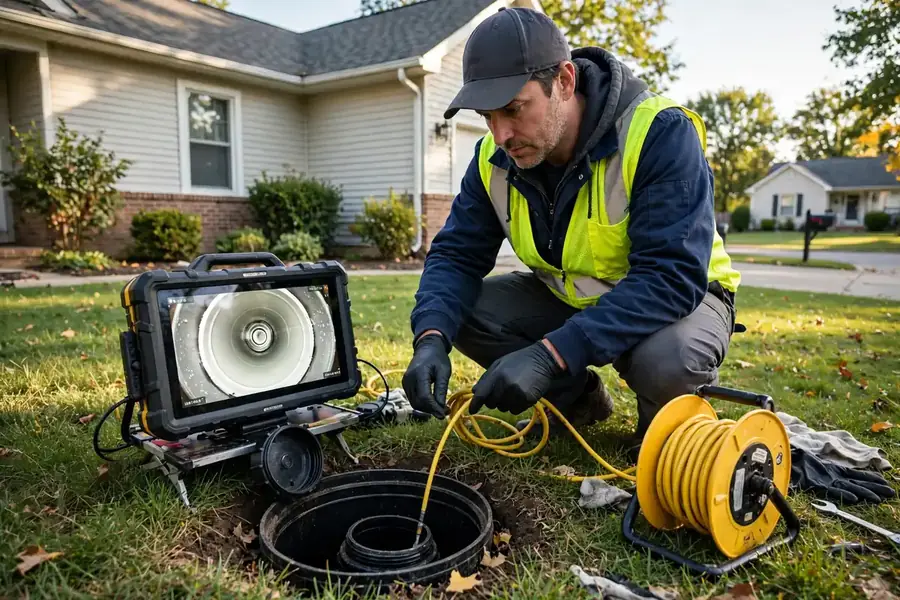
The camera travels the lateral, comparing current condition against the baseline: new root entry, advancing scale, developing bellies, joint movement.
- 3
Cleaning as indicated
Hydro jetting, mechanical cutting, or both — matched to what the camera shows, not a one-size routine. Light buildup gets light cleaning; root masses get cutters.
- 4
Root management
Where roots are the chronic issue, the visit includes cutting plus a discussion of long-term options: continued scheduled cutting or lining to seal the joints permanently.
- 5
Findings and interval setting
You get the updated footage and a plain-English status: what changed, what held steady, and when the next visit should be — 12, 18, or 24 months based on evidence.
- 6
Escalation flags
If the camera shows a defect crossing from maintenance territory into repair territory — a new collapse risk, a rapidly advancing belly — it is flagged now, with repair options, before it becomes an emergency.
Equipment and Materials Used
Maintenance uses the diagnostic and light-cleaning toolkit:
- Push cameras with recording for baseline-to-visit comparison
- Hydro jetters with nozzles matched to buildup type
- Cable machines with root-cutting heads for intrusion management
- Locators for tracking defect positions over time
- Digital record-keeping of footage and findings per visit
The most valuable maintenance equipment is the archive: year-over-year footage that shows whether a line is stable, slowly declining, or suddenly changing.
Safety and Precautions
Maintenance visits are low-impact — no excavation, brief water-use pauses during cleaning, and the same chemical-free approach as any professional cleaning. The main precaution is honest scoping: maintenance manages aging pipe, it does not resurrect failed pipe. If a camera check reveals collapse or severe deformation, the ethical move is repair discussion, not another cleaning sold as a solution.
Homeowners should keep their footage archive — ask for the recording after each visit. It is the line's medical record: future technicians, future buyers, and future you all benefit from a documented history. And avoid chemical 'maintenance' products between visits; caustic cleaners endanger technicians, damage older pipe, and never address the structural causes that professional maintenance monitors.
Maintenance Against Bartlett-Area Conditions
The area's conditions practically write the maintenance schedule. Glacial clay holds moisture that keeps roots aggressive deep into fall, so root-prone lines under the area's mature tree canopy want the shorter end of the cleaning interval — 12 months rather than 24. Freeze-thaw works joints apart a little more each winter, which is why the camera check matters as much as the cleaning: the footage catches the joint that moved since last year before it becomes the joint that fails.
Housing era sets the starting program. Orangeburg-belt homes in Addison, Elk Grove Village, and Streamwood are on replacement-watch maintenance — the visits monitor deformation until bursting is scheduled. Clay-tile neighborhoods in Bloomingdale, Hanover Park, and Palatine run root-management programs. Newer PVC in South Elgin and Carol Stream mostly needs a baseline and infrequent checks. One program does not fit all; the baseline inspection customizes it to the pipe in the ground.
Sewer Maintenance Across the Service Area
Every community gets sewer maintenance — pick yours.
Sewer Maintenance in Addison
Sewer Maintenance in Addison 60101 — scheduled cleaning and camera checkups on plan; postwar pipe by Salt Creek, Addison.
Sewer Maintenance in Bartlett
Sewer Maintenance in Bartlett 60103 — scheduled cleaning and camera checkups on plan; newer PVC; wetland tables, Bartlett.
Sewer Maintenance in Bloomingdale
Sewer Maintenance in Bloomingdale 60108 — scheduled cleaning and camera checkups on plan; transition-era pipe, Bloomingdale.
Sewer Maintenance in Carol Stream
Sewer Maintenance in Carol Stream 60188 — scheduled cleaning and camera checkups on plan; planned PVC; industrial demand, Carol Stream.
Sewer Maintenance in East Dundee
Sewer Maintenance in East Dundee 60118 — scheduled cleaning and camera checkups on plan; Fox River clay; 2000s PVC, East Dundee.
Sewer Maintenance in Elgin
Sewer Maintenance in Elgin 60120 — scheduled cleaning and camera checkups on plan; century clay and iron, Elgin.
Sewer Maintenance in Elk Grove Village
Sewer Maintenance in Elk Grove Village 60007 — scheduled cleaning and camera checkups on plan; Centex Orangeburg aging, Elk Grove Village.
Sewer Maintenance in Geneva
Sewer Maintenance in Geneva 60134 — scheduled cleaning and camera checkups on plan; downtown clay; valley watch, Geneva.
Sewer Maintenance in Glendale Heights
Sewer Maintenance in Glendale Heights 60139 — scheduled cleaning and camera checkups on plan; 1960s–70s cohort ending, Glendale Heights.
Sewer Maintenance in Hanover Park
Sewer Maintenance in Hanover Park 60133 — scheduled cleaning and camera checkups on plan; 1970s clay and Orangeburg, Hanover Park.
Sewer Maintenance in Hoffman Estates
Sewer Maintenance in Hoffman Estates 60192 — scheduled cleaning and camera checkups on plan; multi-era quadrants, Hoffman Estates.
Sewer Maintenance in Itasca
Sewer Maintenance in Itasca 60143 — scheduled cleaning and camera checkups on plan; 1840s to 2010s pipe, Itasca.
Sewer Maintenance in Palatine
Sewer Maintenance in Palatine 60067 — scheduled cleaning and camera checkups on plan; 60–150-year downtown clay, Palatine.
Sewer Maintenance in Rolling Meadows
Sewer Maintenance in Rolling Meadows 60008 — scheduled cleaning and camera checkups on plan; 1950s–60s clay, Rolling Meadows.
Sewer Maintenance in Roselle
Sewer Maintenance in Roselle 60172 — scheduled cleaning and camera checkups on plan; 1970s Orangeburg window, Roselle.
Sewer Maintenance in Schaumburg
Sewer Maintenance in Schaumburg 60193 — scheduled cleaning and camera checkups on plan; Woodfield transition; I-90, Schaumburg.
Sewer Maintenance in South Elgin
Sewer Maintenance in South Elgin 60177 — scheduled cleaning and camera checkups on plan; youngest stock, precision, South Elgin.
Sewer Maintenance in St. Charles
Sewer Maintenance in St. Charles 60174 — scheduled cleaning and camera checkups on plan; three-era Fox mosaic, St. Charles.
Sewer Maintenance in Streamwood
Sewer Maintenance in Streamwood 60107 — scheduled cleaning and camera checkups on plan; Orangeburg risk; shape first, Streamwood.
Sewer Maintenance in Wayne
Sewer Maintenance in Wayne 60184 — scheduled cleaning and camera checkups on plan; estate laterals; vintage clay, Wayne.
Sewer Maintenance in West Chicago
Sewer Maintenance in West Chicago 60185 — scheduled cleaning and camera checkups on plan; century railroad-core pipe, West Chicago.
Sewer Maintenance in Wood Dale
Sewer Maintenance in Wood Dale 60191 — scheduled cleaning and camera checkups on plan; 1960s–70s; Salt Creek floodplain, Wood Dale.
Sewer Maintenance FAQs
Is a maintenance plan worth it for a line with no problems?
Yes — that is exactly when it pays. A baseline camera inspection plus scheduled checks catch root intrusion, scale, and joint movement years before they become emergencies. Prevention costs a fraction of a 2 a.m. backup.
How often should maintenance visits happen?
Evidence sets the interval: root-prone lines every 12 months, moderate lines every 18 to 24, newer PVC every few years. The first baseline visit determines your line's schedule.
Can maintenance prevent a sewer line replacement?
It can delay it significantly and sometimes avoid it — lining a deteriorating line found early is cheaper than replacing a collapsed one found late. But maintenance cannot reverse material end of life; Orangeburg at 60 years will still need replacement eventually.
What is included in a maintenance visit?
Camera condition check with recording, cleaning matched to findings (jetting, cutting, or both), root management, and a written status with the next recommended interval. You keep the footage.
How do I start?
Call (833) 713-2101 and ask for a baseline sewer inspection. The first visit maps the line, establishes its condition, and sets the maintenance schedule from evidence.
Sewer Line Problems Don’t Wait. Neither Should You.
Get a local sewer maintenance specialist on the line now — Bartlett, IL and nearby communities, 24/7 emergency help.
(833) 713-2101Free to call · No obligation · 24/7 emergency line
Serving Bartlett, IL and surrounding suburbs