
Sewer Line Replacement in Bartlett, IL
Sewer line replacement means the old lateral comes out of service and a new pipe takes its place — the definitive fix when repair methods can no longer restore reliable flow. Replacement becomes the honest recommendation in a handful of situations: pipe that has collapsed or lost its round shape entirely, a line installed with the wrong slope so waste never drains properly, or material simply at the end of its life, like Orangeburg fiber pipe from the 1960s that has deformed into an oval.
In short: Sewer line replacement installs a new lateral for Bartlett, IL 60103 homes when the old pipe is beyond repair — collapsed, back-pitched, or at material end of life. The first step is a camera inspection to confirm replacement is truly needed; call (833) 713-2101 to arrange one.
Sewer Line Replacement
Sewer line replacement means the old lateral comes out of service and a new pipe takes its place — the definitive fix when repair methods can no longer restore reliable flow. Replacement becomes the honest recommendation in a handful of situations: pipe that has collapsed or lost its round shape entirely, a line installed with the wrong slope so waste never drains properly, or material simply at the end of its life, like Orangeburg fiber pipe from the 1960s that has deformed into an oval. In those cases, lining or spot repairs would be money spent on a pipe that cannot hold the fix.
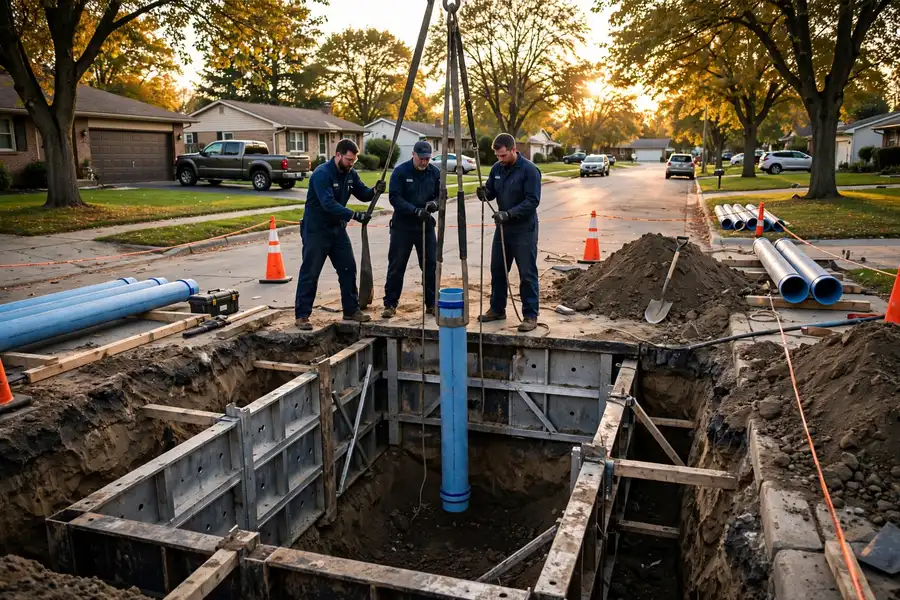
Replacement in the Bartlett area takes two forms. Open-trench replacement excavates the lateral's path, removes the failed pipe, and lays new pipe at the correct grade. Trenchless replacement — pipe bursting — fractures the old pipe outward and pulls new HDPE pipe through in the same operation, needing only entry and exit pits. The camera inspection decides which form fits: bursting needs a traceable path and room to expand, while open trench handles anything, including lines that must be rerouted or re-graded. Either way, the new pipe is modern material with a long service life ahead of it.
Signs Your Sewer Line Needs Replacement, Not Repair
Repairs fix defects; replacement fixes pipes. These findings on a camera inspection are what push the recommendation from repair to replacement:
- Collapsed or missing sections — Where the camera cannot pass because the pipe has caved in, there is nothing left to line or patch. Replacement — by bursting or open trench — is the only way to restore the run.
- Back-pitched or bellied runs — A lateral installed flat or with low spots holds standing water and solids no matter how often it is cleaned. Correcting grade means re-laying the pipe, which is replacement work.
- Orangeburg pipe past its life — Bituminized fiber pipe from the 1940s–1970s deforms and delaminates with age; by 50-plus years it is typically oval or collapsed. Bursting was practically designed for this pipe.
- Pervasive root destruction — A few root intrusions can be cut and lined. A line where roots have entered at every joint and crushed sections between them has no salvageable structure left.
- Repeated failures after repairs — When spot repairs keep failing — new breaks appearing upstream of last year's fix — the pipe system as a whole is done. Continuing to patch it costs more over time than replacing it once.
- Failed inspections requiring new pipe — Point-of-sale or municipal inspections sometimes require full replacement rather than repair, particularly where the lateral is undersized, misaligned at the main, or made of unapproved material.
How Sewer Line Replacement Works, Step by Step
Replacement is the biggest sewer job a homeowner faces, so the sequence matters. Here is the standard progression:
- 1
Camera inspection and written findings
The lateral is camera-mapped end to end: material, diameter, depth, defect locations, and connection points. You see the footage and receive a clear explanation of why replacement — not repair — is recommended.
- 2
Method selection: bursting vs. open trench
If the path is traceable and the surface above is worth protecting, pipe bursting replaces the line through two pits. If the line needs re-grading, rerouting, or the pipe is gone entirely, open trench is the method.
- 3
Utility locates and permits
Gas, electric, water, and telecom lines in the work corridor are marked, and municipal permit and inspection requirements are confirmed before excavation begins.
- 4
Excavation and old pipe removal
Open trench opens the lateral's path and the failed pipe comes out. In bursting, the head fractures the old pipe outward as new HDPE follows — the old material stays buried as fragments around the new line.
- 5
New pipe laid at proper grade
The replacement line is bedded and graded so waste flows by gravity to the municipal main — typically a quarter-inch of fall per foot, verified as the run progresses.
- 6
Connections, backfill, and final camera run
The house connection and the main tap are made, the trench is backfilled in lifts and compacted, and the camera runs the new line to document a clean, continuous, properly graded pipe.
Equipment and Materials Used
Replacement crews bring the heaviest equipment in sewer work:
- Excavators and trenching equipment sized to the depth of the lateral
- Pipe bursting rigs with expander heads matched to the old pipe diameter
- High-density polyethylene (HDPE) or PVC replacement pipe
- Laser levels and grade rods for setting correct pipe slope
- Bedding aggregate and compaction equipment for stable backfill
- Push cameras for the before-and-after documentation runs
Modern replacement pipe — HDPE or PVC — is jointless or uses gasketed joints at wide spacing, a decisive upgrade over clay tile's joint-every-few-feet construction that invited root entry for decades.
Safety and Precautions
Open-trench work follows excavation safety practice: trenches are sloped or shored per depth, spoil piles sit back from the edge, and nobody enters an unprotected trench. Utility locates happen before any digging — striking a gas or electric line is the nightmare scenario, and the northwest suburbs' crowded utility corridors make the locate step critical. The work zone stays fenced or clearly marked, and children and pets are kept clear of equipment and open excavation.
During replacement the home's drains are out of service in stages; the crew coordinates timing so the household knows exactly when water use must pause. If the lateral connects near the street, traffic and sidewalk safety become part of the plan. Homeowners should also confirm who restores the surface — lawn, driveway sections, sidewalk squares — and get that in writing before work starts, along with the permit and inspection schedule for their municipality.
Replacement Realities in the Bartlett Area
Depth is the first local factor. Northern Illinois frost lines push footings and laterals deep — many Bartlett-area laterals run six to nine feet down, which makes open trenching a serious excavation and strengthens the case for bursting wherever the line qualifies. Clay soil complicates the dig: it holds trench walls reasonably but turns to heavy, sticky spoil that is slow to move and must be managed on tight suburban lots.
The second factor is pipe era. Neighborhoods built in the 1960s–70s — Addison, Elk Grove Village, Streamwood, Hanover Park — are the Orangeburg belt, where replacement is often a when-not-if conversation. Historic cores in Elgin, West Chicago, and East Dundee carry clay tile and cast iron at 70 to 100-plus years, where collapse risk rises every year. Newer PVC subdivisions rarely need full replacement unless settlement or construction damage is involved. The camera reads which story your street is telling.
Sewer Line Replacement Across the Service Area
Every community gets sewer line replacement — pick yours.
Sewer Line Replacement in Addison
Sewer Line Replacement in Addison 60101 — full lateral replacement, trenchless or open-trench; postwar pipe by Salt Creek, Addison.
Sewer Line Replacement in Bartlett
Sewer Line Replacement in Bartlett 60103 — full lateral replacement, trenchless or open-trench; newer PVC; wetland tables, Bartlett.
Sewer Line Replacement in Bloomingdale
Sewer Line Replacement in Bloomingdale 60108 — full lateral replacement, trenchless or open-trench; transition-era pipe, Bloomingdale.
Sewer Line Replacement in Carol Stream
Sewer Line Replacement in Carol Stream 60188 — full lateral replacement, trenchless or open-trench; planned PVC; industrial demand, Carol Stream.
Sewer Line Replacement in East Dundee
Sewer Line Replacement in East Dundee 60118 — full lateral replacement, trenchless or open-trench; Fox River clay; 2000s PVC, East Dundee.
Sewer Line Replacement in Elgin
Sewer Line Replacement in Elgin 60120 — full lateral replacement, trenchless or open-trench; century clay and iron, Elgin.
Sewer Line Replacement in Elk Grove Village
Sewer Line Replacement in Elk Grove Village 60007 — full lateral replacement, trenchless or open-trench; Centex Orangeburg aging, Elk Grove Village.
Sewer Line Replacement in Geneva
Sewer Line Replacement in Geneva 60134 — full lateral replacement, trenchless or open-trench; downtown clay; valley watch, Geneva.
Sewer Line Replacement in Glendale Heights
Sewer Line Replacement in Glendale Heights 60139 — full lateral replacement, trenchless or open-trench; 1960s–70s cohort ending, Glendale Heights.
Sewer Line Replacement in Hanover Park
Sewer Line Replacement in Hanover Park 60133 — full lateral replacement, trenchless or open-trench; 1970s clay and Orangeburg, Hanover Park.
Sewer Line Replacement in Hoffman Estates
Sewer Line Replacement in Hoffman Estates 60192 — full lateral replacement, trenchless or open-trench; multi-era quadrants, Hoffman Estates.
Sewer Line Replacement in Itasca
Sewer Line Replacement in Itasca 60143 — full lateral replacement, trenchless or open-trench; 1840s to 2010s pipe, Itasca.
Sewer Line Replacement in Palatine
Sewer Line Replacement in Palatine 60067 — full lateral replacement, trenchless or open-trench; 60–150-year downtown clay, Palatine.
Sewer Line Replacement in Rolling Meadows
Sewer Line Replacement in Rolling Meadows 60008 — full lateral replacement, trenchless or open-trench; 1950s–60s clay, Rolling Meadows.
Sewer Line Replacement in Roselle
Sewer Line Replacement in Roselle 60172 — full lateral replacement, trenchless or open-trench; 1970s Orangeburg window, Roselle.
Sewer Line Replacement in Schaumburg
Sewer Line Replacement in Schaumburg 60193 — full lateral replacement, trenchless or open-trench; Woodfield transition; I-90, Schaumburg.
Sewer Line Replacement in South Elgin
Sewer Line Replacement in South Elgin 60177 — full lateral replacement, trenchless or open-trench; youngest stock, precision, South Elgin.
Sewer Line Replacement in St. Charles
Sewer Line Replacement in St. Charles 60174 — full lateral replacement, trenchless or open-trench; three-era Fox mosaic, St. Charles.
Sewer Line Replacement in Streamwood
Sewer Line Replacement in Streamwood 60107 — full lateral replacement, trenchless or open-trench; Orangeburg risk; shape first, Streamwood.
Sewer Line Replacement in Wayne
Sewer Line Replacement in Wayne 60184 — full lateral replacement, trenchless or open-trench; estate laterals; vintage clay, Wayne.
Sewer Line Replacement in West Chicago
Sewer Line Replacement in West Chicago 60185 — full lateral replacement, trenchless or open-trench; century railroad-core pipe, West Chicago.
Sewer Line Replacement in Wood Dale
Sewer Line Replacement in Wood Dale 60191 — full lateral replacement, trenchless or open-trench; 1960s–70s; Salt Creek floodplain, Wood Dale.
Sewer Line Replacement FAQs
How do I know replacement is needed instead of a repair?
The camera footage decides. Collapse, pervasive deformation, wrong grade, or material at end of life across the whole run means repair methods cannot restore reliable service. A reputable specialist shows you the footage and explains exactly which finding rules repair out.
Does replacement always mean digging up my whole yard?
Not necessarily. Pipe bursting replaces the line through two access pits, leaving the surface between them intact. Open trench is needed when the line must be re-graded or rerouted, or where bursting cannot run. The inspection determines which applies.
How long does a sewer line replacement take?
Most residential replacements complete in two to four working days, depending on length, depth, method, and weather. Bursting jobs often finish faster than open trench because there is far less excavation and restoration.
What pipe material is used for the new line?
Typically HDPE for bursting or PVC for open trench — both modern, root-resistant materials with long expected service lives, and both a major upgrade over clay tile or Orangeburg.
Will my landscaping and driveway be restored?
Discuss restoration before work begins and get it in writing: what gets replaced, to what standard, and on what timeline. With bursting, surface disruption is limited to the access pits; with open trench, the full path needs restoration planning.
Sewer Line Problems Don’t Wait. Neither Should You.
Reach a Bartlett-area sewer line replacement specialist right now — free call, no obligation, 24/7 emergency line.
(833) 713-2101Free to call · No obligation · 24/7 emergency line
Serving Bartlett, IL and surrounding suburbs