
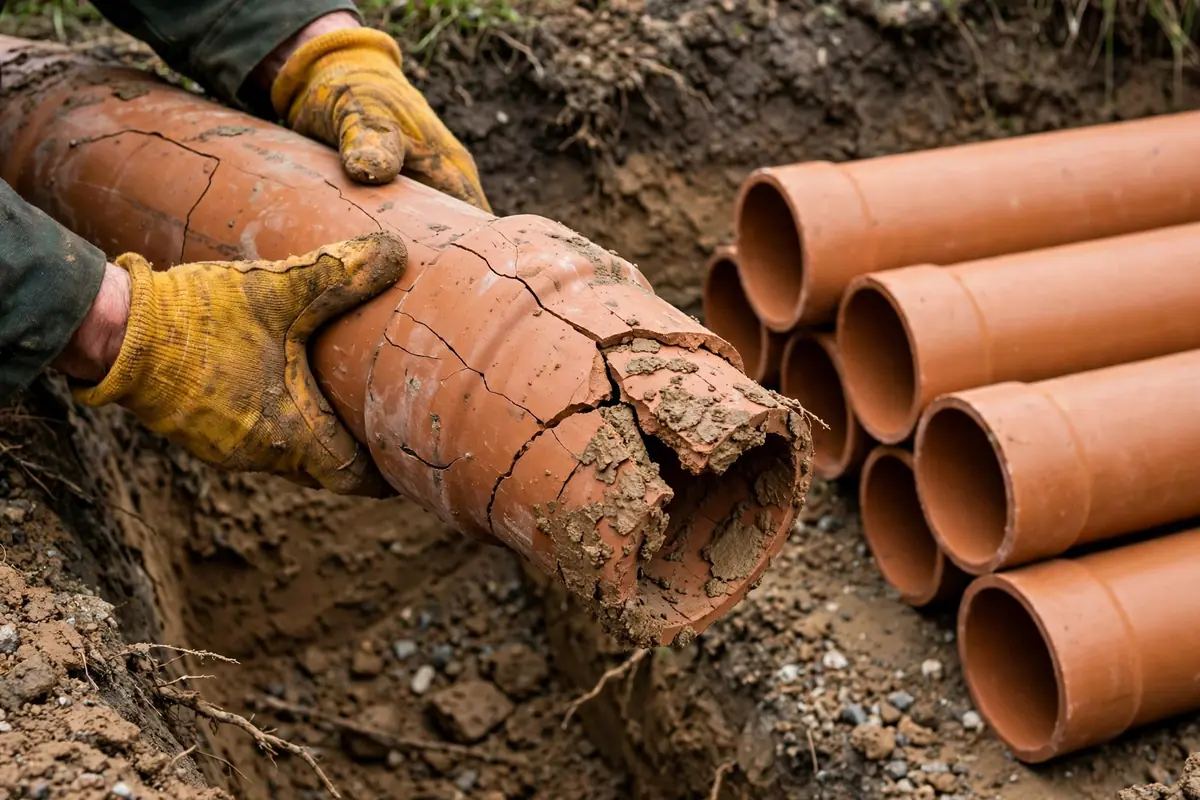
Why So Many Bartlett Homes Have Clay Laterals
Vitrified clay was the standard sewer pipe material for much of the twentieth century. It resists chemical corrosion beautifully, handles the steady flow of a gravity sewer well, and was affordable and widely available when Bartlett's subdivisions were being built out. If your home dates from the 1940s through the early 1970s, there is a strong chance your lateral is clay tile.
Clay pipe came in short sections — typically two to three feet long — joined with mortar, oakum, or later rubber gaskets. That means a sixty-foot lateral can have twenty or more joints, and every joint is a potential entry point for roots and a potential separation point as ground moves. The pipe barrels themselves are durable; the joints are the vulnerability.
Knowing your pipe material changes every maintenance decision. A clay line needs different care — and different replacement timing — than cast iron or PVC, so confirming what is underground is step one. A camera inspection identifies the material visually in minutes.
How Clay Pipes Age and Fail
Clay does not corrode, but it is brittle. Decades of freeze-thaw soil movement, minor settlement, and root pressure create hairline cracks that grow with each cycle. Unlike flexible materials that bend, clay absorbs the stress until it fractures — usually starting at the joints, the weakest points.
Joint failure is the classic clay story. Mortar joints crumble with age, rubber gaskets harden and shrink, and each failed joint admits roots and soil. Roots then do what roots do: expand the opening year after year until the joint is more root than pipe.
The end stage is structural: cracked barrels, offset sections, and eventually partial collapse under soil load. Clay fails gracefully for a long time — giving warnings through slow drains and root blockages — and then fails suddenly when a weakened section gives way. The warnings are the time to act.
Warning Signs Your Clay Line Is Near the End
Recurring root blockages at the same joints are the signature symptom. If your line needs root cutting every year or two, the joints are open and the roots are established — clearing treats the symptom while the openings grow. Each clearing buys less time than the last.
Camera findings tell the rest: multiple cracked sections, offset joints, visible soil infiltration, or standing water in bellies. One isolated crack in a clay line is repairable; a camera run that looks like a highlight reel of defects is a line asking for replacement.
Age plus symptoms is the practical formula. A fifty-plus-year-old clay lateral with any recurring problem is living on borrowed time, and planning its replacement on your schedule beats meeting it as an emergency. Our guide to what causes sewer line collapse explains how clay's end stage typically unfolds.
Repair Options for Clay Lines
For clay lines with isolated defects and sound overall structure, trenchless lining is often ideal. The liner seals every joint and crack in one continuous tube, eliminating the joint vulnerability that defines clay pipe. A lined clay line gets a new jointless interior with decades of life ahead.
Pipe bursting is the answer for clay lines with widespread damage. The bursting head fractures the brittle clay easily — clay is actually an excellent bursting candidate — and pulls in a new fused HDPE line with no joints at all. You keep the route, lose the joints, and gain a modern pipe.
Spot repairs have a place for single defects: one cracked section excavated and replaced, or one bad joint sealed. But be honest about the line's overall condition first — a spot repair on a systemically failing clay line is the most expensive way to learn that lesson twice.
Planning the Replacement Before It Plans You
The smartest move with an aging clay lateral is planned replacement during a season you choose. Summer and early fall offer the most favorable working conditions and scheduling flexibility; emergency replacements happen in February slush or during holiday backups, when everything costs more in stress if not in dollars.
Start with a sewer line replacement assessment in Bartlett: camera footage, a defect map, and a candid discussion of lining versus bursting versus excavation for your specific line. That assessment turns a vague worry about old pipes into a concrete plan with a timeline.
And keep the documentation. The pre-replacement video, the installation records, and the post-installation camera run become part of your home's file — proof of a new lateral that future buyers will value and future plumbers will thank you for. Call (833) 713-2101 to start with the inspection.