
Aging Pipe Materials Reach Their Limit
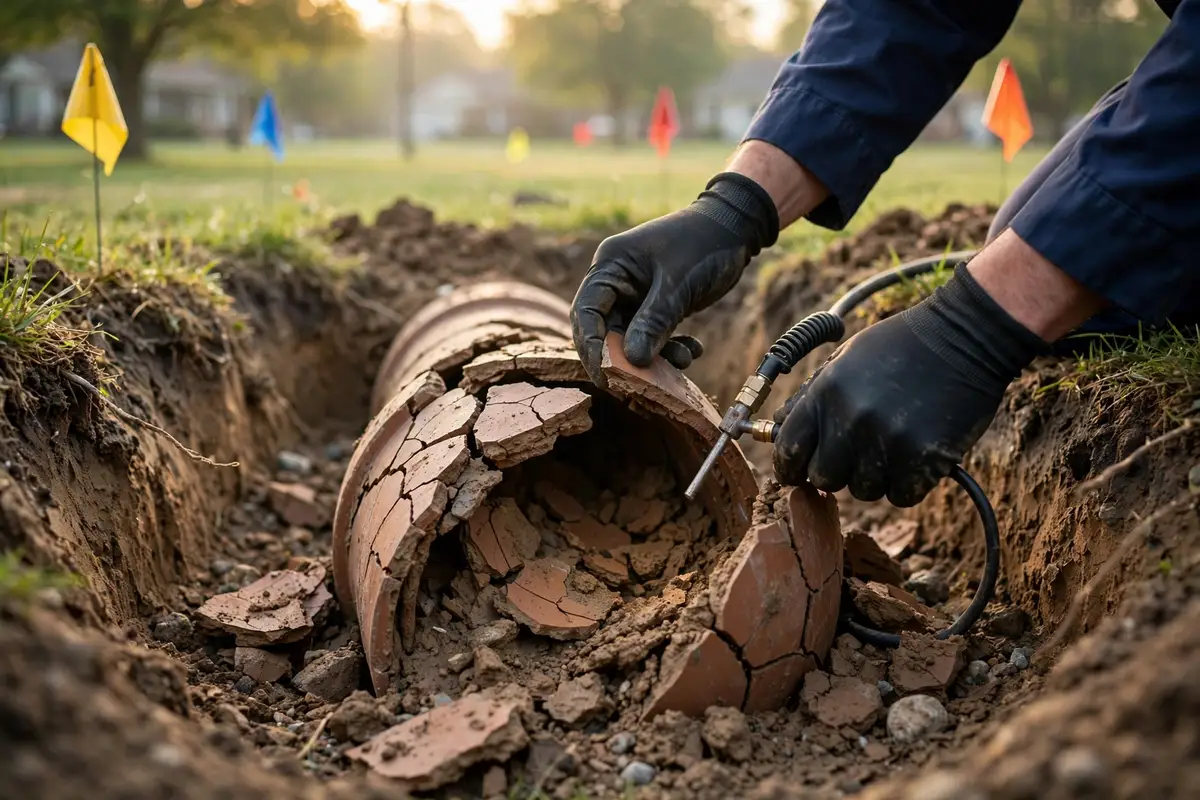
Every pipe material has a lifespan, and much of Bartlett's housing stock is old enough to test those limits. Clay tile lines — common in mid-century homes — become brittle with age and crack under soil pressure. Cast iron corrodes from the inside out, thinning until the pipe wall can no longer support the earth above it.
Orangeburg pipe, a tar-paper composite used in some post-war installations, is the most collapse-prone of all. It deforms under pressure over decades, eventually flattening into an oval and then failing completely. If your home was built in the 1940s through 1960s and still has its original line, a camera inspection is overdue.
Even newer PVC can fail if it was installed poorly. Insufficient bedding, rocks pressing against the pipe wall, or heavy equipment driving over a shallow trench can crack or deform plastic pipe within years rather than decades. Installation quality matters as much as material choice.
Tree Roots: Slow Pressure That Wins
Tree roots do not smash through pipes like a cartoon — they slip into tiny joint gaps and hairline cracks seeking moisture, then grow thicker year after year. A root mass several inches thick exerts enormous radial pressure on the pipe wall, and in brittle clay or corroded cast iron, that pressure eventually wins.
The cruel part is that roots often hold a failing pipe together for a while. Homeowners get the line cleared, flow returns, and everyone assumes the problem is solved — until the weakened section finally gives way. Recurring root blockages in the same spot are a strong signal that the pipe structure itself is compromised.
Spring is peak root-growth season in northern Illinois, which is why backups that return every April or May deserve a structural look, not just another clearing. A tree root removal service can clear the intrusion, but only a camera shows whether the pipe behind it is still sound.
Soil Movement and Freeze-Thaw Cycles
Illinois soil moves. Freeze-thaw cycles heave the ground upward in winter and let it settle unevenly in spring, flexing buried pipe with every cycle. Over decades, that flexing fatigues rigid materials like clay and cast iron, opening joints and eventually cracking barrels.
Erosion is the quieter cousin of frost heave. A leaking joint washes fine soil out from around the pipe, creating a void. With its support gone, the pipe sags into the void — a belly — and the sag concentrates stress until the pipe cracks. Poorly compacted trench backfill from the original installation accelerates this process.
Heavy surface loads add the final straw: new driveways, delivery trucks, or construction equipment over a shallow or weakened line. If a collapse follows shortly after heavy work in the yard, the timing is probably not a coincidence.
Corrosion From the Inside Out
Cast iron and concrete pipes corrode chemically as well as mechanically. Hydrogen sulfide gas in the sewer converts to sulfuric acid on the pipe crown, eating away the top of the pipe in a process engineers call crown corrosion. The pipe looks fine from the outside while the top half thins to paper.
Household chemicals contribute on a smaller scale. Harsh drain cleaners, paint, and solvents poured down drains attack pipe walls and joints. Grease buildup traps corrosive gases against the pipe surface instead of letting them vent. None of these acts alone, but together they shorten a line's life by years.
Warning Signs and What Comes Next
A line heading toward collapse usually telegraphs its decline: backups that return within months of clearing, gurgling across multiple fixtures, a persistent soggy or sunken patch in the yard, or a faint sewage odor outdoors. Any one of these after a cold winter or a wet spring deserves a video camera inspection — it is the only way to see structural damage before the line fails completely.
If the camera confirms a collapse, the repair options depend on the extent. A short collapsed section can sometimes be replaced with pipe bursting in Bartlett, which pulls a new pipe through the old path with minimal digging. Longer failures or badly misaligned lines may need conventional excavation for part of the run.
The key insight: catching structural damage at the cracked stage, before full collapse, usually means a smaller, simpler repair. That is why recurring symptoms should never be treated with repeated clearings alone — each clearing buys time but does not stop the underlying decay.