
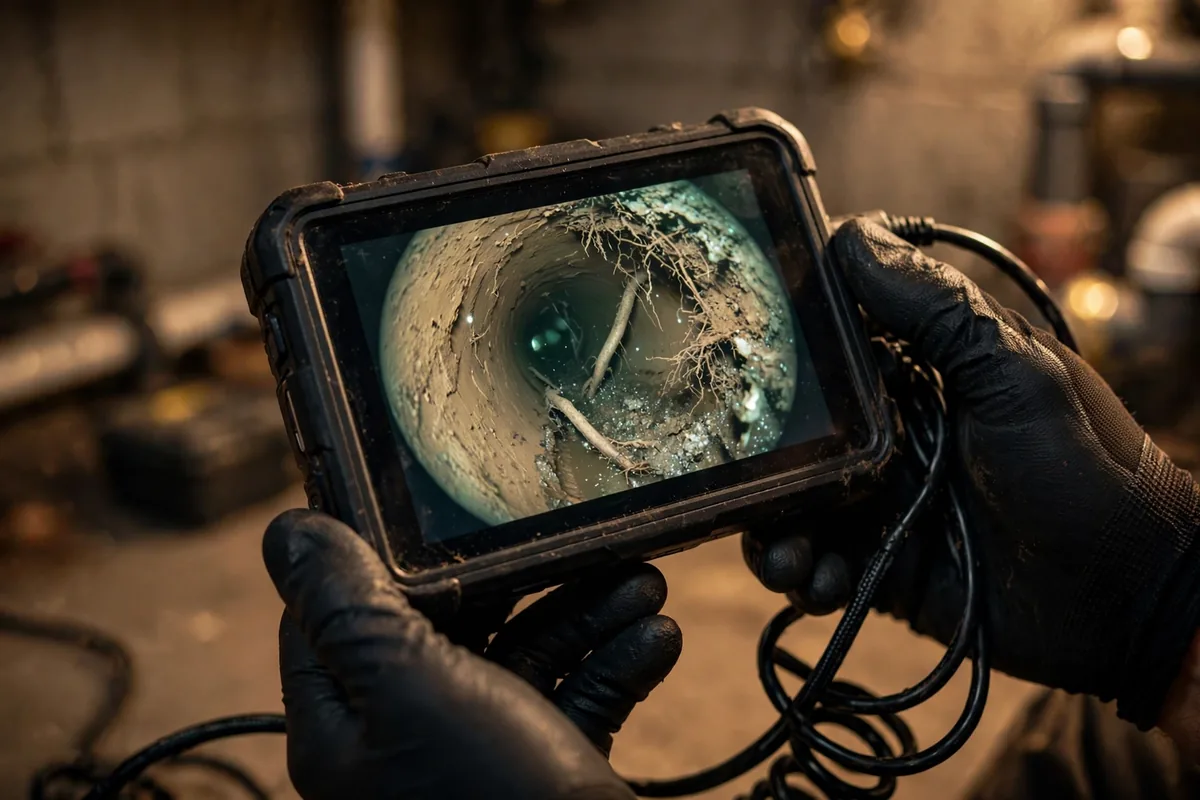
How the Inspection Works
The technician feeds a flexible push-rod with a self-leveling, high-resolution camera head into your line through a cleanout or a pulled toilet. A locator sonde in the camera head transmits a signal, so the technician can mark the camera's exact position and depth from above ground at every point of interest.
You watch the live feed together on a monitor as the camera travels from your house to the street. Distances are measured by an onboard counter, so every root mass, crack, and joint is logged by footage — fifty-three feet out, six feet deep, for example. Most residential inspections take forty-five minutes to an hour.
Afterward you receive a recording of the run, usually with narration or a written summary of findings. Keep that video. It is the baseline record of your line's condition, useful for insurance claims, real estate transactions, and comparing against future inspections.
Roots, Cracks, and Separated Joints
The most common findings in older Bartlett lines are root intrusions at joints and hairline cracks in clay or cast iron. On camera, roots look like pale fibrous masses waving in the flow; cracks appear as dark lines, sometimes with soil visible behind them or water seeping in.
Separated joints show as a visible step or gap where one pipe section has shifted away from the next. Even a small offset catches paper and waste, and the camera shows exactly how many inches the joint has moved — the detail that determines whether the section can be lined or needs replacement.
The location data matters as much as the image. A root intrusion eight feet from the cleanout under the lawn is a very different repair than the same intrusion forty feet out under the driveway, and the footage tells the technician which before anyone picks up a shovel.
Bellies, Scale, and Grease Buildup
A belly — a low sag in the line where water pools — is unmistakable on camera: the lens dips under standing water and the view goes murky until it climbs out the other side. Bellies collect solids, cause recurring slowdowns, and cannot be fixed by cleaning; the section needs regrading or replacement.
Scale and tuberculation in cast iron look like rough, rust-colored barnacles narrowing the pipe. Heavy scaling can reduce a four-inch line to two inches of actual flow area, and the camera shows whether descaling is worthwhile or the pipe is too far gone.
Grease appears as yellowish-brown coating, sometimes in rippled layers, thickest downstream of the kitchen. The camera reveals how much of the line is affected, which guides the choice between sewer line cleaning and full high-pressure hydro jetting — a thin coating needs less aggression than a line choked to half its diameter.
Collapses and Major Structural Damage
A collapse on camera is dramatic: the image goes from pipe interior to a wall of soil and debris, sometimes with daylight or roots pouring through. Partial collapses show as jagged, displaced sections where the pipe's round profile is visibly crushed.
The footage also distinguishes a true collapse from a severe belly or offset, which matters enormously for the repair plan. Collapsed sections generally cannot be lined and need bursting or excavation; bellies and offsets sometimes can. That distinction, made from video evidence, can save thousands in unnecessary digging.
If the camera cannot pass at all, the distance counter still tells you exactly where the impassable point is. Even a failed pass produces actionable intelligence: the blockage location, marked on the surface with paint, ready for targeted repair.
When Bartlett Homeowners Should Book One
Book an inspection when you have recurring symptoms — repeat backups, chronic slow drains, or gurgling that returns after clearings. It is also the smart move before buying a home with an older lateral, before major landscaping over the line's path, and after any nearby construction or heavy equipment work.
Spring is an ideal season: winter's freeze-thaw has done its worst, root growth is visible, and scheduling is easier before the summer rush. A sewer camera inspection in Bartlett in May gives you the full picture in time to plan summer repairs on your terms.
Think of it as the highest-value information in the project. Every repair decision — clear, line, burst, or excavate — depends on knowing what is actually down there, and an hour with a camera replaces all the guessing. Call (833) 713-2101 and ask what the visit includes before you book.