
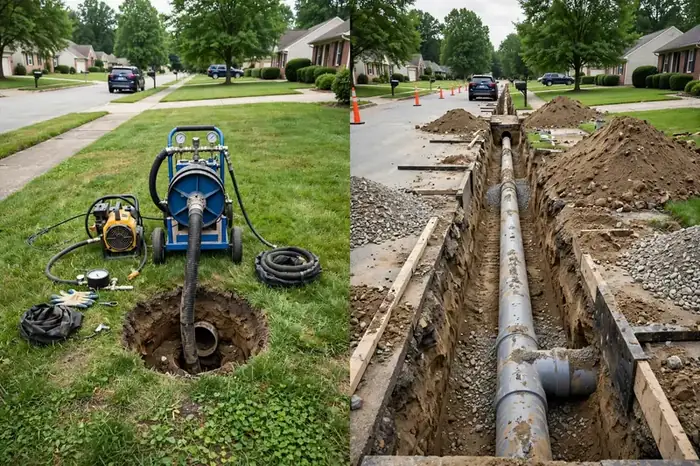
How Traditional Excavation Repair Works
Traditional repair is exactly what it sounds like: the crew locates the damaged section, excavates a trench along the pipe's path, removes the old pipe, installs new pipe, backfills, compacts, and restores the surface. It is the oldest method and still the most universally applicable — any pipe, any damage, any soil condition can be handled with a big enough trench.
The trade-off is disruption. A full lateral replacement by excavation can mean a trench three to six feet deep running the length of your yard, through lawns, gardens, driveways, or patios. Restoration — reseeding, repaving, rebuilding — is a significant part of the project, and mature landscaping in the trench path is usually lost.
Excavation also has the longest timeline. Between digging, pipe work, inspections, backfill compaction, and surface restoration, a traditional replacement often spans several days, during which the yard is an active construction zone.
How Trenchless Methods Work
Trenchless repair comes in two main forms. Pipe lining (CIPP) installs a resin-saturated liner inside the existing pipe, which cures into a smooth, jointless new pipe within the old one — no removal necessary. Pipe bursting pulls a new HDPE pipe through the old line, fracturing the old pipe outward as the new one takes its place.
Both methods need only small access pits — typically one at each end of the repaired section — instead of an open trench. Your driveway, patio, and prize rose bushes stay where they are. Most residential trenchless jobs complete in a day, and you can usually use your plumbing again quickly.
The new pipe materials are excellent. Cured-in-place liners and fused HDPE both offer jointless interiors that resist roots and corrosion, with service lives measured in decades. When the existing line qualifies, trenchless is not a compromise — it is an upgrade. Our trenchless sewer repair page covers the options in detail.
Head-to-Head: The Factors That Matter
Landscape impact is trenchless's biggest win. If your lateral runs under a new driveway, a mature garden, or an expensive patio, avoiding a trench can save thousands in restoration alone — often more than any difference in the repair itself.
Timeline favors trenchless too: one day versus several. For households that cannot easily relocate during construction, or businesses that cannot close, that speed has real value beyond convenience.
Upfront cost comparisons are trickier. Trenchless per-foot pricing can look higher on the quote, but once you add excavation's restoration costs — new sod, repaving, replanting — the totals often converge or favor trenchless. Always compare all-in project costs, not just the pipe-work line item.
When Digging Is Still the Right Answer
Trenchless has real limits, and an honest contractor will tell you when you have hit them. A fully collapsed section with no remaining pipe channel cannot be lined and may defeat bursting. Severe offsets where pipe sections have shifted inches apart, or a line with major bellies that need regrading, require excavation to correct the geometry.
Access constraints matter too. Pipe bursting needs room for the pulling equipment at both ends; a line buried under a structure with no pit access may force a traditional approach. Extremely shallow lines sometimes cost less to excavate conventionally than to mobilize trenchless equipment.
Be skeptical of any quote that prescribes a method before a camera inspection. The inspection reveals exactly which defects exist and where — and therefore which methods are actually viable for your line. Method-first selling, in either direction, is a red flag.
Making the Decision for Your Property
Start with the camera footage, not with a preference. Ask the technician to explain which trenchless methods your specific defects qualify for and why — a good tech will point at the screen and show you. Get the assessment in terms of your pipe, not generic marketing.
Then weigh your property's constraints: what sits above the line, how fast you need it done, and the all-in cost including restoration. For many Bartlett homes with landscaping worth protecting, a trenchless repair in Bartlett wins on total project cost and disruption — but only the camera can confirm your line is a candidate.
Whatever you choose, verify the outcome. A post-repair camera run should show smooth, continuous pipe, and your contractor should provide the video. That recording is your proof of what was installed and your baseline for the decades ahead — call (833) 713-2101 to start with an inspection.