
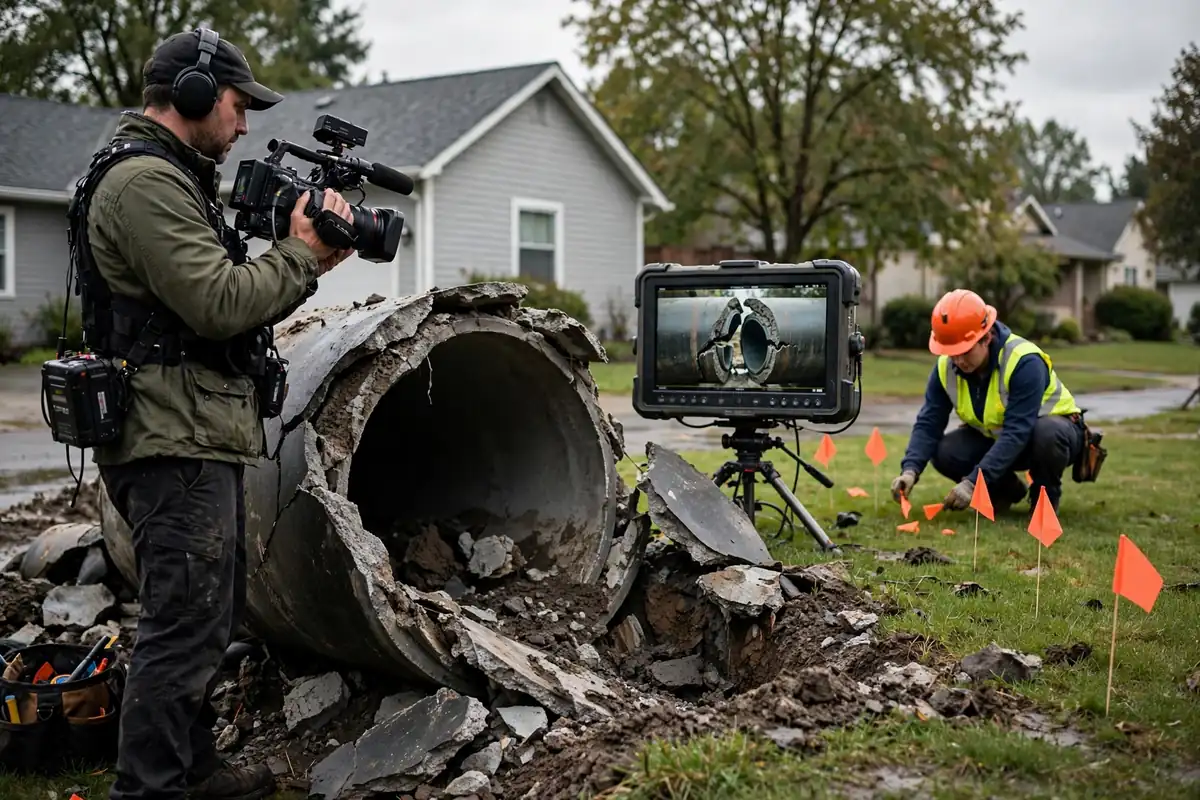
Collapsed Sections With No Channel Left
Pipe lining needs a host pipe: the liner is inverted or pulled through the existing line and cured in place, using the old pipe as a mold. If the pipe has fully collapsed into a pile of fragments and soil, there is no mold — the liner has nothing to follow and nowhere to cure.
Pipe bursting is more forgiving, since it only needs a path to pull through, but even bursting has limits. A long collapsed section filled with compacted soil can stop the bursting head, and a collapse directly under a structure may leave no room to work. The camera shows the extent; the technician judges the feasibility.
The key distinction is partial versus full collapse. A partially collapsed section with a remaining channel can sometimes be lined or burst successfully. A fully collapsed run is excavation territory, and no honest contractor will tell you otherwise.
Severe Offsets and Misaligned Joints
When ground movement shifts one pipe section inches away from its neighbor, the result is an offset joint — a step in the pipe wall that catches waste and disrupts flow. Small offsets can be lined over; the liner bridges the step and restores a smooth interior.
Large offsets are a different story. If sections have separated by a significant fraction of the pipe diameter, a liner cannot span the gap reliably, and the structural discontinuity remains. These joints need to be excavated, realigned, and properly bedded — there is no trenchless shortcut for geometry that far gone.
Multiple offsets along a run compound the problem. Each one is a potential lining failure point, and a line with several major offsets is usually telling you the bedding has failed comprehensively. Excavation with proper new bedding fixes the cause, not just the symptoms.
Bellies That Need Regrading
A belly — a sagging section where wastewater pools — is a grade problem, not a pipe-wall problem. Lining a belly gives you a beautifully smooth new pipe that still sags in exactly the same place, still collecting solids and still causing backups. The geometry is the disease; the pipe wall is just a symptom.
The only cure for a belly is correcting the grade: excavate, rebed, and relay the section at proper slope so wastewater flows through instead of sitting. Pipe bursting does not fix bellies either, since the new pipe follows the old pipe's path — including the sag.
This is one of the most common reasons a line that seems like a lining candidate gets redirected to excavation. If your camera inspection shows standing water in a distinct low section, expect the excavation conversation, and be glad the camera caught it before anyone sold you a liner.
Access and Site Constraints
Trenchless equipment needs room to work. Pipe bursting requires pits at both ends of the run large enough for the pulling apparatus; lining needs access for the inversion equipment and curing setup. A lateral running beneath a building addition, a pool, or a structure with no pit access may simply not be reachable trenchlessly.
Shallow lines present an economic constraint rather than a technical one. Mobilizing trenchless equipment has fixed costs, and for a line only two feet deep in open lawn, conventional excavation can be simpler and cheaper. Trenchless shines where digging is expensive — under driveways, patios, and mature landscaping.
Utility congestion is another factor. A corridor packed with gas, electric, and water lines leaves no safe path for bursting heads or lining equipment without extensive hand work. The utility locate, done before any method decision, sometimes rules trenchless out on safety grounds alone.
How to Protect Yourself From Overselling
the strongest single protection is a camera inspection you watch yourself, with the recording in your hands. When a contractor says trenchless will or will not work, ask them to point at the screen and show you the specific defect driving the recommendation — the collapse, the offset, the belly.
Get the limitation in writing as part of the assessment. A reputable company documents why a line qualifies or does not, defect by defect. Vague claims like ‘this always works trenchless’ or ‘this can never be lined’ without video evidence are sales tactics, not engineering.
Finally, remember that needing excavation is not a failure. A sewer line replacement by open trench, done with proper bedding and inspection, gives you a brand-new line with a known condition — often the strongest outcome for a badly damaged pipe. And when the line does qualify, trenchless repair in Bartlett remains an excellent choice. The camera at (833) 713-2101 tells you which story is yours.