
Sign 1: Multiple Drains Slowing Down at Once
One slow sink is a local clog. Every drain in the house slowing together — kitchen, bathrooms, laundry — is a main-line problem. The lateral carries everything out, so when it narrows from roots, grease, or damage, the symptom shows up everywhere at once.
Pay attention to timing. If the slowdown appeared gradually over months, buildup or root intrusion is likely. If it arrived suddenly after heavy rain, groundwater may be infiltrating a cracked line. Either way, whole-house slowness is the single most reliable early warning of lateral trouble.
Sign 2: Gurgling Toilets and Drains
Gurgling happens when air is trapped in the line and forced back through traps. A healthy sewer line vents air smoothly through the roof stack; a partially blocked or damaged line cannot, so the air bubbles up through the nearest fixture instead.
Note which fixtures gurgle and when. A toilet that gurgles when the washing machine drains points to a restriction in the main line between them and the street. Occasional gurgles after heavy water use are worth a sewer camera inspection even if everything still drains — it is the sound of a problem developing.
Sign 3: Sewage Odors Inside or Outside
Persistent sewage smells mean the sealed system is breached. Indoors, the usual entry points are dry traps, failed toilet seals, or a cracked drain line under the slab. Outdoors, the smell points to a leaking lateral or a damaged cleanout cap.
Do not normalize the smell. Homeowners sometimes live with a faint basement odor for a year, assuming it is just how old houses smell, while a cracked line steadily washes soil away underground. An odor that does not resolve with trap refills and basic checks needs professional diagnosis.
Sign 4: Backups That Keep Coming Back
A single backup can be a fluke — a one-time blockage from something that should not have been flushed. Backups that return within months of a clearing are not flukes; they are the signature of a structural problem like root intrusion at a broken joint, a bellied section that collects waste, or a partial collapse.
Each repeat backup also raises the stakes. Sewage exposure damages flooring, drywall, and belongings, and insurance may balk at covering damage from a known recurring issue you did not address. After the second backup, stop clearing and start diagnosing.
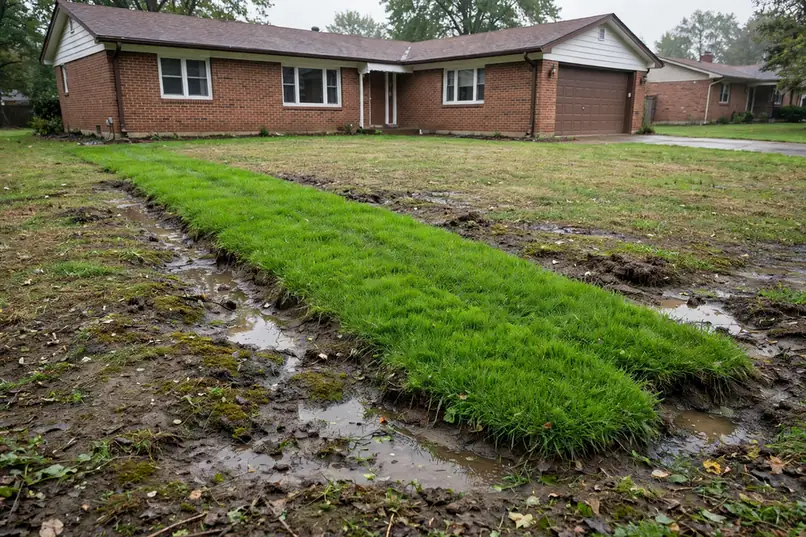
Sign 5: Unusually Lush or Fast-Growing Grass Patches
Wastewater is fertilizer. A strip of grass above your sewer lateral that grows faster, greener, and lusher than the surrounding lawn is feeding on a nutrient leak below. Homeowners often mow that one weird stripe for a season before realizing what it means.
Walk your yard in spring when growth differences are most visible. If the lush patch follows a straight line from your house toward the street — the typical lateral path — you have found your leak's address. Mark it and mention it when you call; it helps the technician aim the camera.
Sign 6: Soggy Spots, Sinkholes, or Foundation Cracks
A leaking lateral saturates the soil around it, and saturated soil settles. The result can be a persistently soggy patch that never dries, a shallow depression forming over the line, or in advanced cases, soil washing out from under a driveway or walkway section.
Inside, watch for new foundation cracks or a basement floor that seems to shift. While many foundation issues have other causes, a leaking sewer line undermines the soil the foundation rests on. When yard and basement symptoms appear together, the sewer line belongs at the top of the suspect list.
Sign 7: Older Pipes and a History of Problems
Context is a warning sign too. If your Bartlett home still has its original clay, cast iron, or Orangeburg lateral and you have needed drain service more than once in recent years, the line is telling you its service life is ending. Materials do not heal; every clearing just resets the countdown.
This is the sign most homeowners ignore because nothing is actively broken today. But a planned trenchless sewer repair on your schedule costs less disruption than an emergency replacement on the sewer's schedule — usually in the middle of a holiday weekend or a deep freeze.
What to Do When You Spot These Signs
One sign deserves attention; two or more deserve a camera inspection. The inspection is non-invasive, takes about an hour, and replaces every guess with video evidence of exactly what is happening inside your line — roots, cracks, bellies, or a clean bill of health.
Bring your observations to the appointment: which fixtures are affected, how long it has been happening, and where the yard symptoms are. That history helps the technician interpret what the camera shows. Then act on the findings while the repair is still a choice rather than an emergency — call (833) 713-2101 to get started.