
What a Yard Sewer Smell Is Telling You
Indoor plumbing is designed as a sealed system — wastewater goes in, gases stay contained, and everything vents through the roof. When you smell sewage outside, that seal is broken somewhere between your house and the street. Something is letting wastewater or gas escape into the soil and air.
The smell often intensifies after rain or during warm weather. Rain saturates the soil and pushes trapped gases upward, while heat accelerates the bacterial activity that produces the odor. If the smell comes and goes with the weather, the source is almost certainly underground rather than a surface issue.
Take the location seriously as a diagnostic clue. A smell concentrated in one spot suggests a single break or joint failure at that point, while a general odor across the yard can indicate a longer deteriorated section or a venting problem at the cleanout.
The Usual Suspects: Broken Laterals and Bad Joints
The most common culprit is a cracked or separated sewer lateral. Clay tile lines are joined every few feet, and each joint is a potential failure point as ground shifts and roots press in. A separated joint leaks wastewater into the surrounding soil with every flush, and the smell rises through the ground above it.
Cast iron laterals fail differently — they corrode and develop pinholes or longitudinal cracks, often near the bottom where waste flows. These leaks can run for months before anyone notices, because the wastewater disperses into the soil. The first sign is frequently the smell, not a backup.
Do not overlook the cleanout. A cracked, missing, or poorly seated cleanout cap vents sewer gas directly into the yard, and it is a five-minute fix. Walk your yard and check every visible cap before assuming the worst — but if the caps are fine and the smell persists, the line itself needs a camera inspection.
Vent Stack and Drain-Field Confusion
Sometimes the smell is not a leak at all. Plumbing vent stacks terminate above the roof, but on calm days or with certain wind patterns, vented gases can settle back down into the yard, especially near the side of the house. If the odor is strongest near an exterior wall and fades a few feet out, have the vent configuration checked.
Homes near older septic systems or with abandoned cesspools on the property can also produce yard odors unrelated to the active sewer line. Property records or a conversation with a longtime neighbor can reveal whether your lot has buried history worth investigating.
One more possibility: a neighbor's problem. Sewer gas travels, and a broken line on the adjacent lot can smell like it is coming from your yard. If your camera inspection comes back clean, the source may be next door — worth mentioning tactfully before you spend money on the wrong property.
How Professionals Track Down the Source
A technician will start with the easy wins — cleanout caps, visible vent terminations, and the path of the lateral — then move to a smoke test if the source is not obvious. Harmless smoke pumped into the system escapes exactly where the pipe is breached, marking the spot above ground with visible wisps.
The camera inspection follows, showing the break, the root intrusion, or the separated joint in high resolution, along with its exact depth and distance from the access point. That footage turns a vague smelly-yard complaint into a precise repair plan with a defined location.
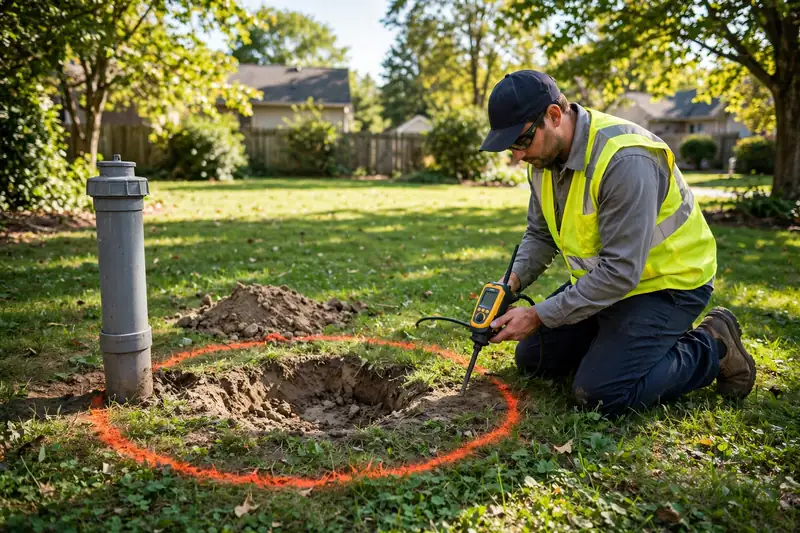
Soil probing around the suspect area can confirm active leakage — saturated, foul-smelling soil at pipe depth is conclusive. Together, these methods eliminate guesswork so the repair targets the real problem on the first attempt.
Lasting Fixes for a Smelly Yard
For a single cracked section or separated joint, a spot repair or a short pipe relining section often solves the problem without disturbing the whole yard. Relining creates a seamless new pipe inside the old one, sealing every joint and crack in the treated length.
When the camera shows widespread deterioration — multiple breaks, heavy root intrusion throughout, or a collapsed section — a full sewer line replacement in Bartlett is the honest recommendation. Patching a line that is failing everywhere just schedules the next emergency.
After any repair, the yard should stop smelling within days as the contaminated soil airs out and bacteria break down the residue. If an odor lingers beyond a week or two, call back — a proper repair eliminates the source completely, and lingering smell means something was missed.