
Step 1: Permits, Locates, and Planning
Every legal installation starts with paperwork. Your contractor pulls a plumbing permit and, where the work touches the public right-of-way, a right-of-way permit — each with inspection checkpoints the work must pass. Skipping permits risks stop-work orders and problems at resale, so verify they are in the scope before anyone digs.
Next comes utility locating: gas, electric, water, telecom, and the existing sewer all get marked on the surface. In established Bartlett neighborhoods with crowded utility corridors, the locate map often determines the installation method — a clear corridor invites excavation or bursting, while congestion may push the plan trenchless.
Planning also fixes the line's design: diameter, material, slope, and connection points. Slope is the critical number — too flat and solids settle, too steep and water outruns solids. The standard quarter-inch per foot is not a suggestion; it is the physics that makes gravity sewers work for decades.
Step 2: Excavation or Trenchless Access
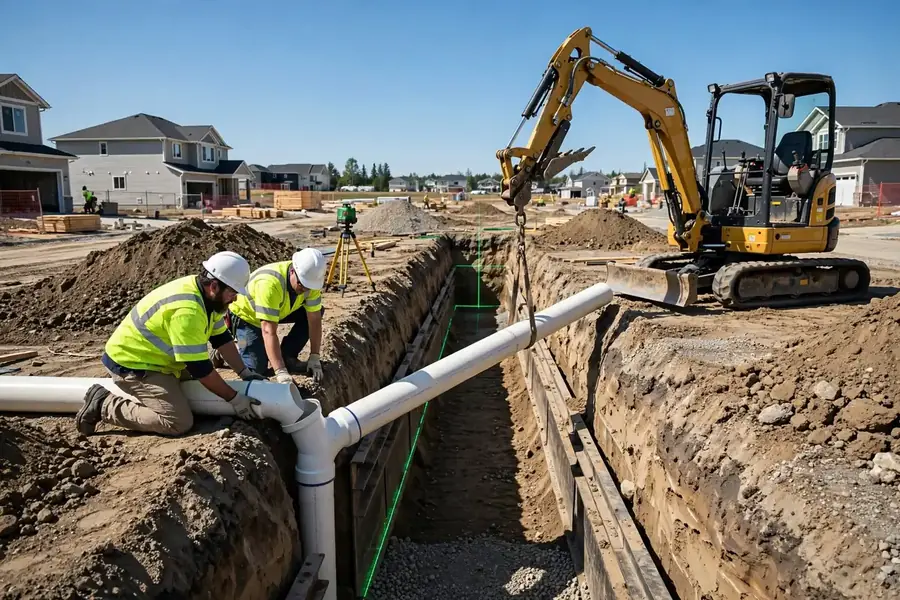
For traditional installation, the crew excavates the trench along the planned route, typically three to six feet deep for a residential lateral in our area — below the local frost line so winter cannot reach the pipe. The trench bottom is graded and bedded with compacted stone or sand to give the pipe uniform, stable support.
For trenchless installation by pipe bursting, the crew digs only launch and receiving pits, then pulls the new pipe through the old line's path. The ‘excavation’ is two modest holes instead of a trench, but the preparation — locates, measurements, equipment staging — is just as rigorous.
Either way, fall ground conditions in northern Illinois are ideal: dry enough for clean excavation, unfrozen for easy digging, and stable for proper compaction. Winter-frozen ground and spring-saturated soil both complicate every step that follows.
Step 3: Pipe Laying, Slope, and Connections
Pipe sections are laid from the downstream end upward, bell ends facing upstream, with each joint fully seated and aligned. The crew checks slope continuously with a laser level — this is the craftsmanship step where decades of performance are determined, and rushing it is how bellies are born.
Connections get special attention: the house connection with its cleanout, any branch tie-ins, and the tap into the public main. Each is sealed, supported, and aligned, because connections are the highest-stress points in any lateral and the most common future failure sites.
Bedding and initial backfill happen immediately around the laid pipe — compacted in lifts, free of large rocks, protecting the pipe from point loads. A pipe is only as good as its bedding; the finest pipe in a poorly bedded trench will belly and offset within years.
Step 4: Inspection, Testing, and Backfill
Before backfill covers the work, the installation faces inspection — typically a municipal inspector verifying slope, materials, bedding, and connections against code. Many installations also get a water or air test proving the line is watertight, and a final camera run documenting the as-built condition.
That camera run is your birth certificate for the new line: smooth joints, correct slope, clean connections, all on video. Keep it with your home records permanently — it is the baseline every future inspection will be compared against, and proof of professional installation for future buyers.
Final backfill is compacted in lifts to prevent the settlement that causes so many problems in older lines, and the surface is restored — sod, seed, or pavement per the permit terms. Proper compaction now prevents the sunken trench line that betrays rushed work a year later.
Why Fall Is the Smart Time to Install in Bartlett
Timing an installation for fall stacks every advantage. The ground is workable but the emergency season has not started; contractors have real availability instead of triage schedules; and the new line enters winter — its first and hardest test — with proper bedding, correct slope, and modern materials.
Contrast that with a winter emergency installation: frozen ground that fights every shovelful, limited daylight, crews juggling freeze-related emergencies, and a homeowner making the biggest plumbing decision of their life under backup pressure. The pipe installed is the same; the experience is not.
If your camera inspection this year flagged a line near the end — aging clay, systemic cracks, recurring root battles — fall is your window to replace it on your terms. A sewer line installation in Bartlett planned now means a worry-free winter — call (833) 713-2101 before the ground freezes and the calendar fills.