
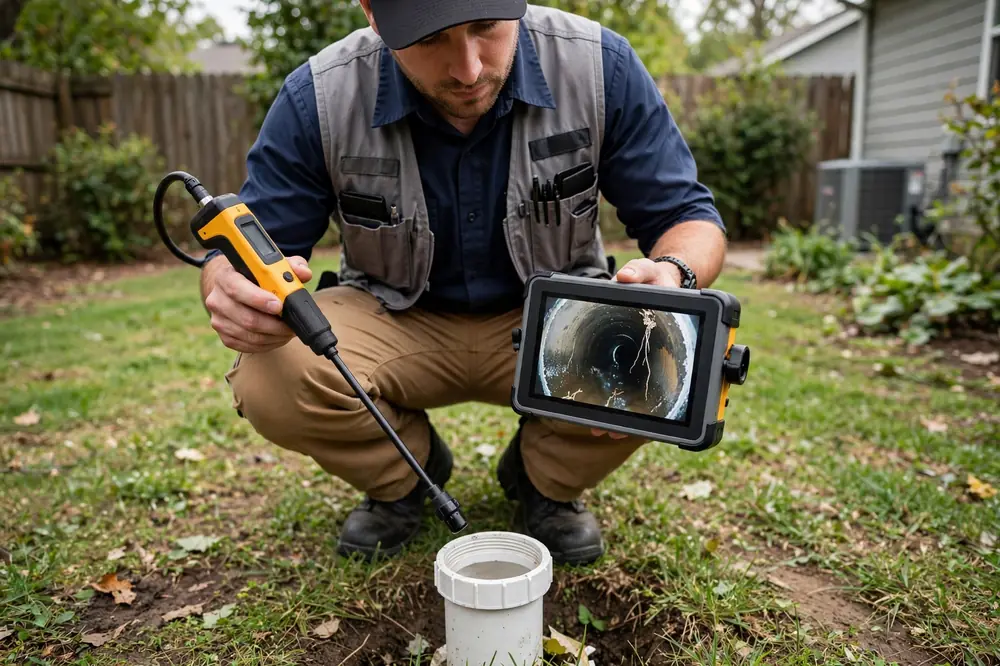
Camera Inspection: Seeing Is Believing
The camera remains the gold standard for leak detection because it shows the defect directly. A crack with water seeping in, a joint with soil visible behind the gap, a section where the pipe wall has thinned — the technician sees the leak's cause, not just its symptoms, along with exact distance and depth.
Its strength is precision and documentation. The video becomes a permanent record: this crack, at this footage, at this depth. That precision lets repairs target a three-foot section instead of trenching a thirty-foot run on a hunch.
The limitation is that cameras see the inside of the pipe. A leak that only flows outward under pressure, or a breach hidden behind standing water or heavy debris, can escape the lens. That is when the indirect methods below earn their keep.
Smoke Testing: Finding Every Breach at Once
In a smoke test, the technician seals the system and blows harmless, visible theatrical smoke into the line. The smoke follows the path of least resistance — which is every crack, separated joint, broken cleanout cap, and faulty seal — and wisps appear above ground or inside the house wherever it escapes.
The great advantage is completeness. Where a camera examines one line segment at a time, smoke tests the entire connected system simultaneously, including branch lines and vent connections the camera may never visit. It is the most effective method for chasing a mysterious odor with no obvious source.
The trade-off is specificity about depth and exact pipe condition. Smoke marks the surface location of a breach but does not show whether the pipe is cracked, offset, or collapsed. Professionals usually follow a smoke test with a targeted video camera inspection at the marked spots to plan the repair.
Dye Testing and Water Tracing
Dye testing introduces a bright, non-toxic fluorescent dye into a fixture or cleanout and watches where the colored water emerges. It answers a different question than the other methods: not where is the pipe broken, but where does this water actually go?
That makes dye ideal for suspected cross-connections, illegal tie-ins, or situations where a wet spot might come from the sewer line, a water line, or groundwater. If the dye appears in the soggy patch, the sewer is the source; if it does not, the investigation turns elsewhere.
Dye is cheap, simple, and definitive for flow-path questions, but it gives no information about the pipe's structural condition. Think of it as a yes-or-no test for source identification rather than a diagnostic of the line itself.
Acoustic Listening and Other Specialty Methods
Acoustic leak detection uses sensitive ground microphones to listen for the sound of water escaping under pressure. It shines on pressurized water lines, but gravity sewer lines are usually unpressurized, so acoustic methods see limited sewer use — mainly for force mains or pumped systems in commercial settings.
Infrared thermography from the surface can sometimes reveal the thermal signature of a leak, since escaping wastewater changes soil temperature and moisture. Results depend heavily on conditions — it works most reliably with a strong temperature contrast and shallow pipe — so it remains a supplementary tool rather than a primary one.
For most residential situations in Bartlett, these specialty methods are overkill. The practical sequence is camera first, smoke test if the camera leaves questions unanswered, and dye when the puzzle is about where water travels rather than where pipe is broken.
Choosing the Right Method for Your Situation
Match the method to the symptom. Recurring backups or slow drains? Start with the camera — you need to see the obstruction or damage. Unexplained sewage odor with no drainage symptoms? Smoke testing finds the breach the camera might miss. Soggy patch of unknown origin? Dye testing identifies the source before anyone digs.
Be wary of anyone who wants to excavate based on symptoms alone. A sewer leak detection visit in Bartlett should produce evidence — video, smoke marks, or dye traces — before a repair plan and certainly before a trench. Diagnostics are cheap; digging in the wrong place is not.
After detection comes the repair decision, and the method often points to it. A single cracked joint found on camera may be a lining candidate; widespread breaches revealed by smoke suggest a line near the end of its life. Good detection does not just find the leak — it frames the fix. Call (833) 713-2101 to start with the right test.