
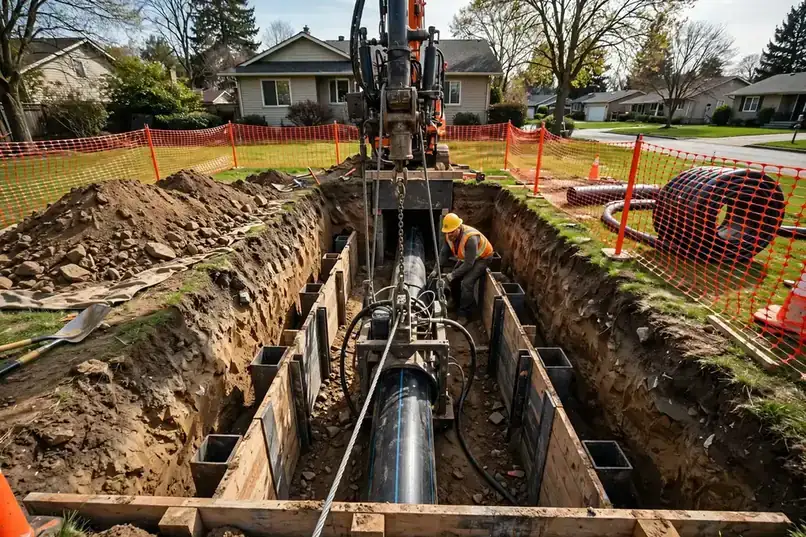
The Core Idea: Replace Without Removing
Traditional replacement removes the old pipe and lays a new one in the open trench. Pipe bursting skips the removal step entirely: a powerful winch or hydraulic puller drags a cone-shaped bursting head through the existing line, and the head's larger diameter fractures the old pipe outward into the surrounding soil as it advances.
Attached directly behind the bursting head is the new pipe — typically high-density polyethylene (HDPE) with heat-fused joints. As the head shatters the old line, the new pipe slides into the freshly opened path in the same continuous motion. Old pipe out of the way, new pipe in place, in one pull.
The genius is that the old pipe's location becomes the new pipe's location. No trench needs to follow the lateral's path across your yard, because the replacement happens underground along the exact existing route, guided by the old line itself.
Step by Step: What Happens on Job Day
The crew starts by excavating two small pits: a launch pit at one end of the run and a receiving pit at the other. These are typically a few feet square — enough for equipment access, not a trench across the property. A camera run beforehand has already mapped the line and confirmed bursting is viable.
Next, the bursting head and new HDPE pipe are staged at the launch pit, with a cable or rod threaded through the old line to the pulling rig at the receiving pit. The pull begins slowly, and the head fractures the old pipe section by section while the new pipe follows. The crew monitors progress and pulling force continuously.
Once the head reaches the receiving pit, the new pipe is in place end to end. The crew connects it to your home's plumbing at one end and the city tap or main at the other, backfills the two small pits, and runs a final camera inspection to verify a clean, continuous installation. Most residential jobs finish in a single day.
The New Pipe: What You Actually Get
HDPE is an outstanding sewer pipe material. It is flexible enough to handle minor ground movement without cracking, chemically resistant to the corrosive sewer environment, and — critically — its joints are heat-fused into a single continuous piece. No joints means no joint gaps for roots to exploit and no seams to separate as soil shifts.
Bursting also commonly allows upsizing. Because the bursting head displaces soil outward, the new pipe can be a size larger than the old one, increasing flow capacity. For homes adding bathrooms or dealing with chronic capacity issues, that upsizing is a meaningful bonus traditional spot repairs cannot offer.
The installed pipe typically carries a long service life measured in many decades. Compared with a conventional sewer line replacement by open trench, bursting delivers the same brand-new pipe with a fraction of the surface disruption. You are not patching an old line; you are getting a new line that happens to travel the old line's route. Keep the post-installation camera video as your proof and baseline.
What Pipe Bursting Handles — and What It Cannot
Bursting handles most common pipe materials: clay tile, cast iron, concrete, Orangeburg, and PVC all fracture predictably under the bursting head. It manages root-intruded lines, cracked sections, and deteriorated pipe along the full run, making it ideal for lines that are failing comprehensively rather than at one spot.
It cannot fix what is not in the pipe's path. Bellies — sagging sections with wrong grade — persist because the new pipe follows the old alignment, sag included. Severe collapses with no remaining channel can stop the head, and the method needs adequate soil around the pipe to absorb the displaced fragments.
Proximity to other utilities is the other constraint. The bursting head expands the old pipe's footprint slightly, so lines running tight against gas, water, or electric need careful evaluation. The pre-job utility locate and camera survey exist precisely to catch these conflicts before the pull begins.
Is Pipe Bursting Right for Your Bartlett Line?
Bursting is the right choice when the camera shows widespread deterioration — multiple cracks, heavy root intrusion throughout, or failing joints along the run — but the line's overall alignment and grade are still sound. That is the sweet spot: pipe walls shot, pipe path fine.
It also shines where the surface above is valuable: under driveways, patios, mature trees, or expensive hardscaping that excavation would destroy. The two small pits can usually be placed to avoid the features you most want to protect.
The way to find out is the same as every sewer decision: a pipe bursting evaluation in Bartlett starting with camera footage. If your line qualifies, you get a brand-new pipe with two small patches of disturbed soil instead of a trench across the yard — call (833) 713-2101 to see if your line is a candidate.