
Step 1: Stop All Water Use Immediately
The moment you see sewage coming up through a drain, toilet, or tub, stop adding water to the system. Do not flush toilets, run faucets, start the dishwasher, or do laundry. Every gallon you send down has nowhere to go and will join the backup, raising the level in the lowest fixtures of your house.
Walk through the house and make sure nobody is unknowingly running water — a shower running upstairs during a main-line backup can flood a basement in minutes. If you have an automatic sump pump or water softener that discharges on a cycle, check whether it drains to the sewer and pause it if you can do so safely.
Step 2: Protect People and Pets From Contamination
Sewage is classified as Category 3 black water, which means it can carry bacteria, viruses, and parasites. Keep children and pets completely away from affected rooms, and avoid walking through standing sewage in bare feet or open shoes. If you must enter the area to shut off a valve or grab valuables, wear rubber boots and gloves.
Turn off your HVAC system if sewage is near a return vent or the furnace area. Forced-air systems can pick up airborne contaminants and distribute them through the whole house. Open a window in the affected room for ventilation if weather allows, but do not run fans that blow across the sewage toward clean areas.
Step 3: Document Everything for Insurance
Before anything is moved or cleaned, photograph and video the backup from multiple angles. Capture water lines on walls, affected flooring and furniture, and any visible source like an overflowing floor drain. These images are the foundation of an insurance claim, and adjusters want to see the damage as-found, not after cleanup.
Write down the timeline while it is fresh: when you first noticed the problem, what fixtures were affected, what the weather was like, and what steps you took. Save receipts for every emergency expense, including the plumber visit and any hotel stay if the house becomes uninhabitable. Our guide to sewer backup insurance coverage walks through what policies typically cover.
Step 4: Do Not Use Chemical Drain Cleaners
It is tempting to pour a bottle of drain cleaner down the affected drain, but during a main-line backup it cannot reach the blockage and will simply sit in the pipe — or worse, in the standing sewage on your floor. That creates a chemical hazard for anyone who later works on the line or cleans up.
Caustic cleaners can also damage older pipes, especially corroded cast iron, and they generate heat that can soften PVC joints. If a professional later needs to snake or jet the line, residual chemicals in the water put them at risk too. Skip the bottle entirely and save your money for the real fix.
Step 5: Call for Professional Help
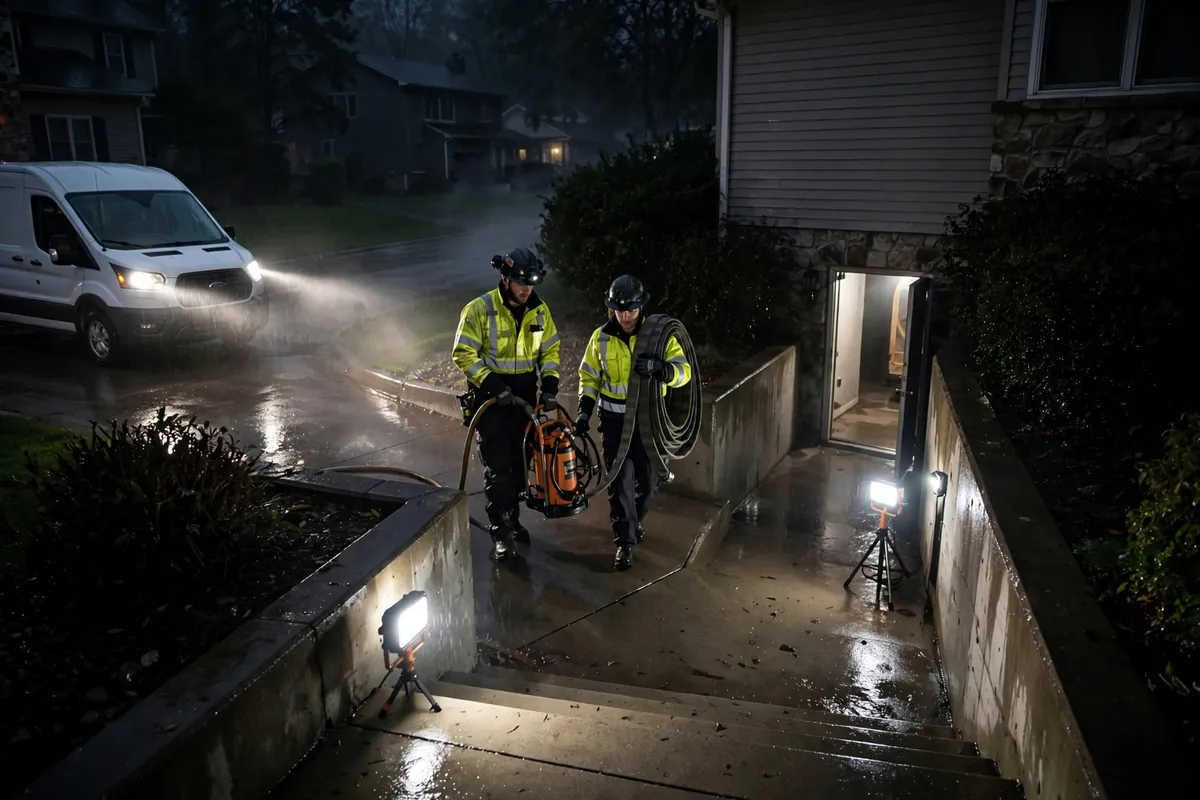
A main-line backup needs professional equipment and expertise. Call (833) 713-2101 and describe exactly what you are seeing: which fixtures are affected, whether it is still rising, and whether you have a basement. That information helps the technician arrive with the right equipment for emergency sewer repair rather than making two trips.
While you wait, locate your sewer cleanout — usually a capped pipe in the yard or basement — and make sure it is accessible. The technician will likely open it to relieve pressure and get a look at the line. If you know where your main water shutoff is, keep that information handy too.
Step 6: Get a Camera Inspection to Find the Cause
Clearing the immediate blockage is only half the job. A camera inspection service shows exactly what caused the backup — tree roots, a collapsed section, heavy grease, or a foreign object — and where in the line it sits. Without that picture, you are guessing, and the backup will likely return.
The footage also becomes valuable documentation. If the blockage turns out to be in the municipal portion of the line or was caused by a known issue, the video supports your case with the city or your insurer. Ask for a copy of the recording and keep it with your claim paperwork.
Step 7: Plan Cleanup With Contamination in Mind
Porous materials that contacted sewage — carpet, padding, drywall below the water line, upholstered furniture — generally cannot be disinfected and should be removed. Hard surfaces need thorough cleaning followed by disinfection with an appropriate product. This is not a mop-and-bucket job; consider a professional restoration company for anything beyond a small contained area.
Do not put contaminated materials in your regular indoor trash or drag them through clean rooms. Bag them at the site, and check local Bartlett-area disposal rules for sewage-contaminated waste. Keep all cleanup receipts alongside your other claim documentation.
Step 8: Prevent the Next Backup
Once the line is clear and the cause is known, fix the root problem rather than just the symptom. Roots can be cut and treated, grease can be removed with hydro jetting service in Bartlett, and a collapsed or bellied section can be repaired or replaced before it fails again. Ask the technician what maintenance interval makes sense for your line.
Consider a backwater valve if backups have happened more than once. Installed on your lateral, it lets sewage flow out but slams shut when flow tries to reverse into your home — cheap insurance against the next municipal surcharge or heavy spring rain.