
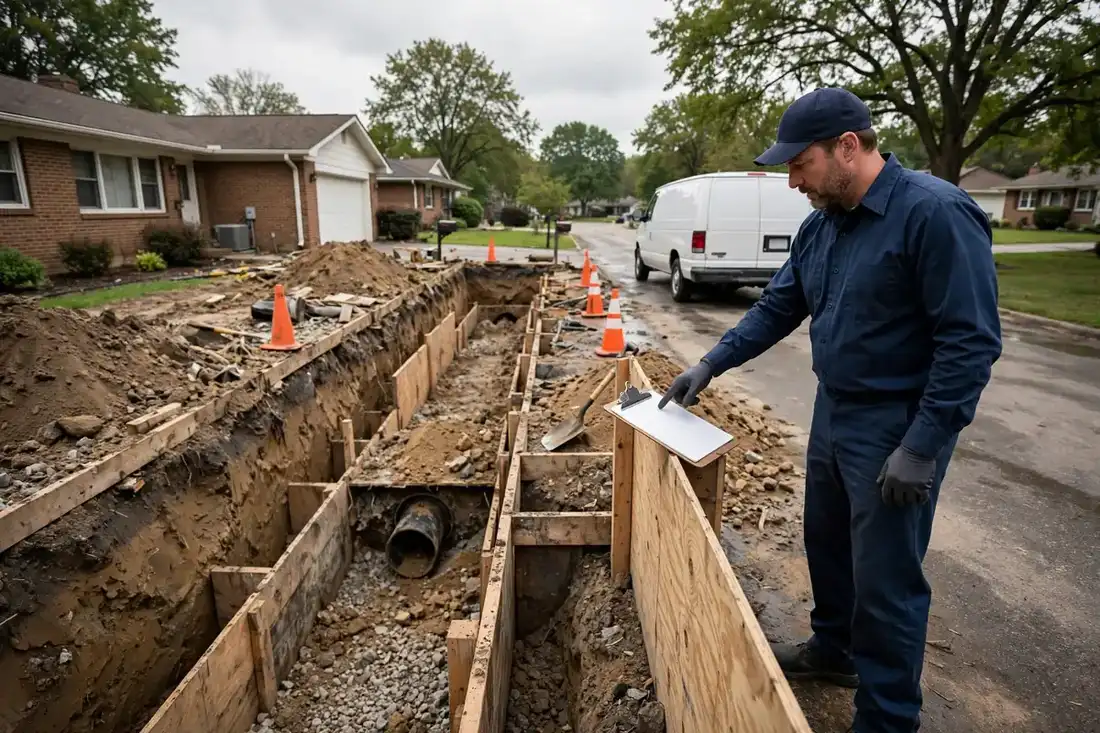
Factor 1: How Much Pipe Is Damaged
Length is the most obvious cost driver. A ten-foot spot repair and a sixty-foot full replacement are different projects with different equipment, labor, and material needs — which is why the camera inspection’s defect map matters so much. The footage defines the project's true scope before anyone prices it.
Distribution matters as much as length. Three damaged spots spread across the run can cost more to address individually than one continuous damaged section of the same total length, because each spot needs its own access, setup, and restoration. This is one reason systemic deterioration often pushes the decision toward full replacement.
Severity compounds it further. A cracked-but-round pipe is a lining candidate; a collapsed section needs bursting or excavation at a different cost tier entirely. The camera does not just measure how much pipe — it classifies what kind of work each foot needs.
Factor 2: The Repair Method
Trenchless methods — lining and pipe bursting — carry different cost structures than open excavation. Trenchless typically shows higher per-foot pipe-work pricing but dramatically lower restoration costs, since only small access pits disturb the surface. Excavation reverses that: simpler pipe work, but the trench, backfill, compaction, and surface restoration add substantial project cost.
Neither method is universally cheaper. Under a new driveway or mature landscaping, trenchless usually wins on total project cost because restoration dominates the math. In open lawn with shallow pipe, traditional excavation can be the economical choice. Compare all-in totals, never just the pipe-work line.
Method feasibility itself is a cost factor. If the camera disqualifies trenchless — collapses, severe offsets, bad bellies — the method decision is made for you, and quotes should reflect the required approach rather than the preferred one.
Factor 3: Depth, Soil, and Groundwater
Deeper pipe means more excavation, more shoring for worker safety, and more dewatering if groundwater is present. A lateral four feet deep and one eight feet deep are different jobs even at identical lengths — the deeper trench needs safety systems, wider excavation, and far more backfill and compaction.
Soil type affects both methods. Rocky soil slows excavation and can complicate bursting; sandy, unstable soil needs more shoring and careful bedding; high groundwater means pumping throughout the job. Bartlett's glacial soils vary lot to lot, which is partly why quotes differ between neighbors with similar houses.
Season interacts with soil too. Frozen winter ground and saturated spring soil both add difficulty — another reason fall scheduling, when conditions are most workable, tends to produce the smoothest projects.
Factor 4: Access and Obstacles
What sits above the line shapes the project significantly. A lateral running under open lawn is the easy case; one under a driveway, patio, deck, retaining wall, or mature trees adds removal, protection, or rerouting work — and restoration afterward. Every obstacle is labor and risk.
Tight lot lines and limited equipment access add their own costs. If excavators cannot reach the work zone and everything must be done by hand or with compact equipment, labor hours climb. Urban and established-suburb lots pay an access premium that open rural properties do not.
Interior access matters for trenchless work. The condition and location of the cleanout — or the need to create access — affects setup complexity. A buried or inaccessible cleanout discovered on job day is the kind of surprise that changes a quote, so locate yours before the estimator visits.
Factor 5: Permits, Inspections, and Code Requirements
Legitimate projects carry permit fees and inspection checkpoints, and quotes should include them transparently. Plumbing permits, right-of-way permits for parkway work, and tap or connection fees where the lateral meets the main are real costs — and skipping them creates legal exposure that dwarfs the fees.
Code requirements can add scope: bringing a nonconforming cleanout up to code during the repair, adding a backwater valve where the municipality requires one, or meeting current bedding and material standards. These are not upsells; they are the legal definition of a complete job.
When comparing quotes, check that each includes the same permit and inspection scope. A quote that omits permits is not cheaper — it is incomplete, and the missing costs arrive later as change orders or violations.
Factor 6: Surface Restoration
Restoration is the most underestimated cost factor and the biggest source of quote-to-quote variation. Resodding a lawn, repaving a driveway section, rebuilding a patio, replanting landscaping — these are skilled trades with real pricing, and ‘restoration included’ can mean anything from rough grading to full replacement of what was there.
Get restoration specified in writing: exactly what surfaces, to what standard, by whom, and on what timeline. Photograph everything before work begins. The most common post-project disputes in sewer work are not about the pipe — they are about the yard.
This factor alone often decides trenchless versus excavation on total cost. When the surface above the line is expensive — new concrete, intricate pavers, mature plantings — avoiding the trench avoids the restoration bill that would have dwarfed the pipe work.
Factor 7: Timing and Urgency
Emergency work costs more than planned work in every trade, and sewer work is no exception. After-hours, weekend, and holiday responses carry premium labor rates; emergency excavations proceed without the scheduling efficiencies of planned projects; and decisions made under backup pressure are rarely the most economical ones.
This is the factor you control most. A fall camera inspection that catches a failing line early converts a February emergency into an October project — same pipe, same repair, fundamentally different experience and economics. Prevention is not just about avoiding damage; it is about buying your repair at planned-project terms.
Document everything from the first symptom for insurance purposes: dates, photos of damage, the camera video, every quote, and all receipts. Our insurance coverage guide explains what documentation adjusters expect. Then get the assessment that turns factors into a firm plan — a sewer line repair evaluation in Bartlett starts with the camera at (833) 713-2101.