
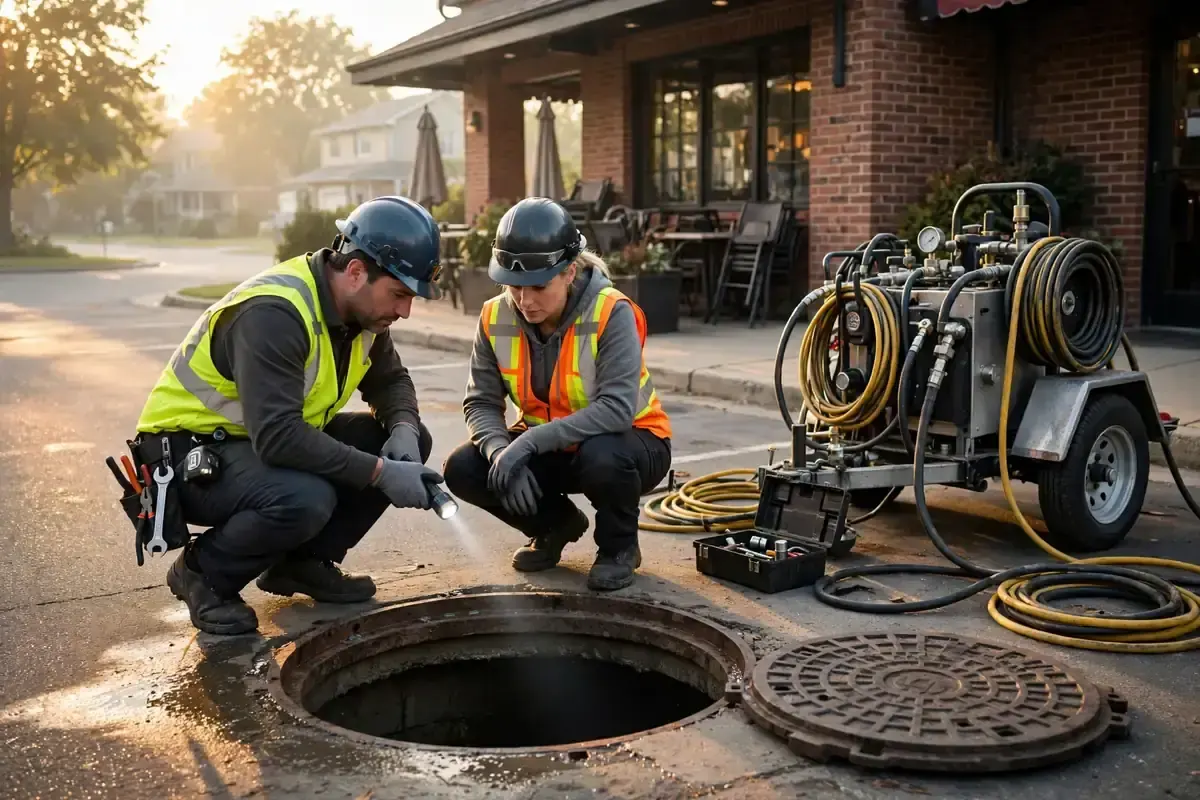
Why Commercial Sewer Work Is a Different Discipline
Commercial sewer systems face loads residential lines never see: restaurant kitchens sending grease by the gallon, retail restrooms serving hundreds of visitors daily, industrial processes with specific discharge characteristics. The pipes may be larger, but so are the consequences when they fail — health department scrutiny, lost business days, and reputational damage that outlasts the repair.
Timing constraints reshape every job. A restaurant cannot have its kitchen line jetted during the lunch rush; a retail store cannot excavate its parking lot on a Saturday. Commercial service is scheduled around the business — early mornings, overnight, or planned closures — which demands a provider organized enough to work to your calendar rather than theirs.
Documentation standards are higher too. Commercial properties need service records for health inspections, lease compliance, insurance, and sometimes franchise requirements. Every visit should produce paperwork: what was found, what was done, and what is scheduled next. If your provider treats documentation as optional, they are not a commercial provider.
Restaurants: The Grease Battle
Food service is the toughest commercial sewer application. Fats, oils, and grease — plus food solids — enter the line constantly, and Illinois winters congeal that grease into blockages with ruthless efficiency. A restaurant without a grease management plan is scheduling its own emergency.
The foundation is the grease trap or interceptor, properly sized, correctly installed, and pumped on schedule — not when someone remembers. Trap neglect is the leading cause of restaurant sewer emergencies, and health inspectors know it. Your pumping records should be as routine as your food orders.
Beyond the trap, the building line needs regular high-pressure hydro jetting to scour the grease film that traps alone cannot stop. Quarterly jetting is common for busy kitchens; the camera footage from each visit tracks whether the interval is right. Fall jetting before the holiday rush is the single highest-value preventive visit a restaurant can buy.
Retail, Office, and Multi-Tenant Properties
Non-food commercial properties have a different risk profile: lower daily loads but higher stakes per incident, because a backup in a retail restroom or office building affects customers, tenants, and lease relationships. The failure mode is usually not grease but wipes, paper products, and the slow accumulation of neglect in lines nobody thinks about until they fail.
Multi-tenant buildings add a coordination challenge: one tenant's misuse becomes everyone's backup. Clear lease language about what goes down drains, tenant education at move-in, and a building-wide maintenance schedule prevent the blame game after an incident.
Winter is the danger season for these properties too. Unoccupied spaces with the heat turned down, holiday closures with no water moving through lines, and spring thaw revealing freeze damage — the commercial calendar has the same seasonal risks as residential, multiplied by square footage. A fall sewer camera inspection before the heating season is cheap insurance.
Minimizing Downtime When Work Is Needed
When repair or replacement becomes necessary, the commercial question is not just how but how fast and how invisibly. Trenchless methods earn their premium in commercial work: a line relined overnight or burst over a weekend reopens Monday with the parking lot intact and no trench through the customer entrance.
Phasing is the other downtime tool. A competent commercial contractor sequences the work — isolating sections, providing temporary facilities where needed, coordinating with your operations manager — so the business functions around the repair rather than shutting down for it. Demand a written phasing plan before work begins.
Communication during the job matters as much as the plumbing. Your provider should brief your designated contact daily: what is done, what is next, and whether the timeline holds. Surprises are for birthdays, not for businesses paying by the closed hour.
Building Your Commercial Maintenance Plan
Start with a baseline: a full camera inspection documenting every line on the property, with footage archived and a defect map. You cannot plan maintenance for infrastructure you have not seen, and the baseline video is the reference for every future comparison.
Set the service calendar by risk: grease-producing tenants get frequent jetting, high-traffic restrooms get regular clearing, older lines get biennial camera checks. Put it in writing, assign responsibility, and review it annually — a plan nobody owns is a plan nobody follows.
Choose a provider that treats your business like a business: scheduled off-hours availability, documented visits, emergency response with realistic windows, and a single point of contact who knows your property. A commercial sewer service plan in Bartlett built around your hours and your risks keeps the doors open through winter and beyond — call (833) 713-2101 to build yours.